
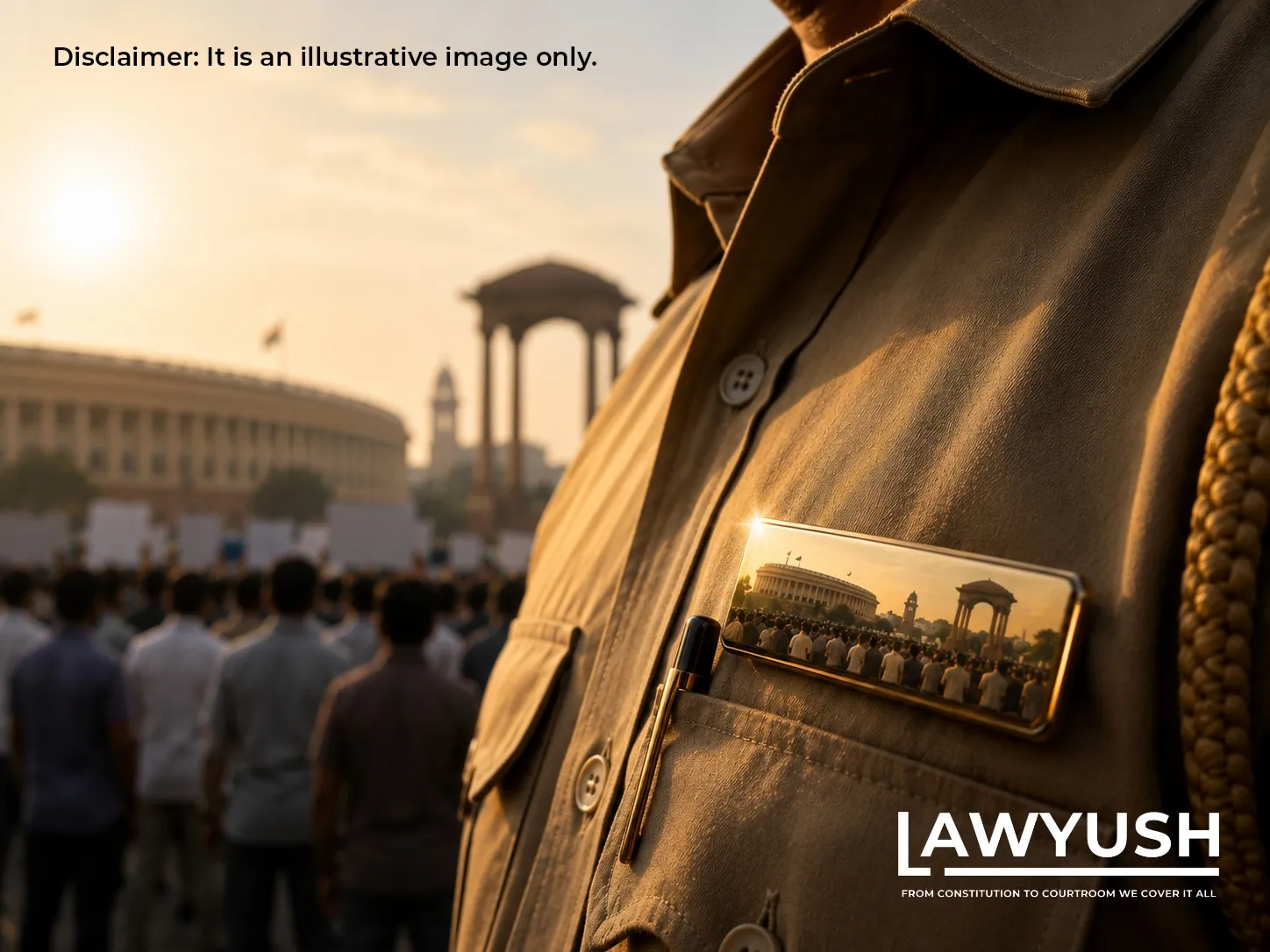
Police Identification During Protests in India has become an increasingly important legal issue as public demonstrations raise questions about transparency, police accountability, and constitutional rights. Whether police officers can conceal their identity while exercising public authority is no longer merely an administrative question; it is a constitutional one.
Can police conceal their identity while managing protests? A legal breakdown of BNSS provisions, D.K. Basu guidelines, and recent judicial precedent on police accountability and civil liberties in India.
Introduction
Picture a public protest. Batons are raised, the crowd is being pushed back, and somewhere in the chaos, an officer in plain clothes or in uniform but without a visible name plate directs the action. If that officer uses excessive force, whom does the citizen name in a complaint? Whom does the court summon? Whom does the public even recognise as having acted unlawfully?
This is not a hypothetical concern. It is a structural gap at the intersection of police power and citizen accountability, one that becomes most visible during protests and public demonstrations, where tempers run high, force is sometimes used, and the line between lawful crowd control and excess is thin.
In a constitutional democracy, the right to protest under Article 19(1)(b) of the Constitution is inseparable from the citizen’s right to know who is policing that protest.
Anonymity in enforcement is not a neutral administrative choice, it is a legal question with real consequences for transparency, due process, and the rule of law. This piece examines what Indian law actually says about police identification during public assemblies, and why the answer matters far beyond any single incident.
The Legal Framework Governing Public Dispersal
Who Has the Authority to Disperse an Assembly?
Under the Bharatiya Nagarik Suraksha Sanhita (BNSS), 2023, Sections 148 to 160 (the successor provisions to Sections 129–144 of the erstwhile CrPC), the power to declare an assembly “unlawful” and order its dispersal is not vested in every member of the police force at will. It is confined to:
- A police officer (of at least the rank prescribed under the relevant provision), or
- An Executive Magistrate.
These provisions authorise use of civil force, and in escalating circumstances, armed force, to disperse an assembly that has been lawfully declared unlawful. This is a significant, coercive state power — and significant powers, under Indian administrative and constitutional law, are accompanied by correspondingly significant accountability safeguards.
When Is Concealing Identity Legally Permissible?
Indian law does recognise narrow, legitimate exceptions where officers may operate
without overt identification:
1. Undercover operations: intelligence-gathering, infiltration of criminal networks, or
covert surveillance where operational secrecy is essential to the objective itself.
2. Specific tactical interventions: certain anti-terror or hostage situations where
identity concealment protects the officer or the operation’s integrity.
These exceptions share a common feature: they are narrow, purpose-specific, and time- bound. They are designed for situations where the nature of the task requires concealment not situations where the convenience of avoiding personal accountability is the driving factor.
Why General Protest Management Doesn’t Fit the Exception
Managing a public protest is fundamentally different from undercover work. It is an overt, public-facing exercise of state authority conducted in daylight, in public view, often before media cameras. There is no operational secrecy to protect.
When officers policing a protest appear in civil clothes or in uniform stripped of name plates, the legal exception simply does not apply and the concealment becomes legally questionable rather than legally justified.
Landmark Case Laws & Judicial Precedents
D.K. Basu v. State of West Bengal (1997)
This is one of the most significant custodial-rights judgments in Indian legal history. While primarily concerned with custodial violence and arrest procedure, the Supreme Court laid down binding guidelines requiring that:
1. Police personnel carrying out an arrest or interrogation must bear accurate, visible, and clear identification displaying their name and designation.
2. This identification requirement exists precisely so that the citizen being subjected to state power can identify and, if necessary, later hold accountable — the specific officer involved.
The underlying principle of D.K. Basu extends logically beyond the arrest context: if identification is essential during an arrest to prevent abuse, it is equally essential during crowd-control operations where force is exercised on a wider, more chaotic scale.
Nallapareddy Prasanna Kumar Reddy v. The State of Andhra Pradesh (2025)
In this more recent matter, the High Court directly engaged with the practical difficulty citizens face when officers act in plain clothes. The Court’s observations centered on a simple but critical question: if a police officer performing an official duty is not in uniform and carries no visible identification, how is a citizen expected to know they are dealing with lawful authority at all?
This precedent is significant because it moves the conversation from arrest-specific procedure (as in D.K. Basu) to the broader operational conduct of police officers performing official functions in public, including crowd and assembly management, reinforcing that identification is not a courtesy, but a legal expectation tied to the legitimacy of state action.
Why Police Identification During Protests in India Matters
Unidentifiable policing during public assemblies creates cascading legal and civic problems:
Broken Chain of Accountability: Without a name or badge number, a citizen alleging excessive force has no starting point for a complaint, an FIR, or a departmental inquiry against a specific officer. Complicated Evidentiary Trail: Courts and internal disciplinary bodies rely on identifiable actors. Anonymity effectively pre-empts the evidentiary process before it begins.
Erosion of Public Trust: Policing operates on a social contract of legitimacy. When enforcement becomes faceless, the public’s confidence in the fairness of law enforcement institutions weakens.
Risk of Unchecked Force: Anonymity can function as a psychological shield, potentially emboldening excessive conduct where individual accountability is diluted.
Difficulty Distinguishing Lawful Officers from Impersonators: An unidentified individual claiming police authority in a crowd cannot be readily verified, creating risks for both citizens and legitimate law enforcement.
Each of these concerns points to the same conclusion: identification is not a bureaucratic formality; it is the mechanism through which police power remains answerable to law.
Conclusion & Takeaways
The right to peaceful protest and the state’s power to maintain public order are not inherently in conflict, but they can only coexist fairly when the exercise of that power remains transparent and traceable. Indian law, through BNSS Sections 148–160 and judicial guidance from D.K. Basu and Nallapareddy Prasanna Kumar Reddy, points consistently toward one principle: police authority exercised in public must be identifiable, except in
the narrowest, purpose-specific undercover circumstances.
Quick Takeaways for Law Students & Citizens
Only a police officer or an Executive Magistrate has the legal authority to order dispersal of an unlawful assembly under BNSS Sections 148–160.
Concealment of identity is legally permissible only in genuine undercover or covert operational contexts not general protest management.
D.K. Basu (1997) mandates clear, visible name and designation badges during official police duties.
Nallapareddy Prasanna Kumar Reddy (2025) reinforces that citizens must be able to identify officers performing official functions, even outside formal arrest.
A citizen has a reasonable legal expectation to be able to identify an officer exercising state power against them; this is foundational to accountability, not an inconvenience to policing.
Understanding this framework equips both citizens and legal professionals to ask the right question in the aftermath of any contested crowd-control incident: not just what happened, but who was accountable for it.
Frequently Asked Questions (FAQs)
1. Can police conceal their identity during protests in India?
Generally, no. Police officers managing public protests are expected to remain identifiable while exercising official authority. Although Indian law permits identity concealment in limited situations such as undercover operations or specific tactical interventions, these exceptions do not ordinarily apply to routine protest management. Visible identification promotes transparency, accountability, and public trust.
2. Is wearing a police name badge mandatory in India?
The Bharatiya Nagarik Suraksha Sanhita (BNSS), 2023 does not expressly mandate the display of name badges during protest policing. However, the Supreme Court in D.K. Basu v. State of West Bengal (1997) directed that police personnel carrying out arrests or interrogations must display clear and visible identification, including their name and designation. This principle reinforces the importance of identifiable policing during the exercise of public authority.
3. What does the BNSS say about protest policing?
Under Sections 148-160 of the BNSS, 2023, an Executive Magistrate or an authorised police officer has the power to declare an assembly unlawful and order its dispersal in accordance with the law. While these provisions regulate the use of force to maintain public order, they do not provide a general exemption allowing police officers to conceal their identity during public-facing law enforcement duties.
4. What did D.K. Basu v. State of West Bengal decide?
In D.K. Basu v. State of West Bengal (1997), the Supreme Court laid down landmark guidelines to prevent custodial abuse and protect individual rights. Among these guidelines, the Court required police personnel involved in arrest or interrogation to wear accurate, visible, and clear identification displaying their name and designation, ensuring accountability for the exercise of police powers.
5. Can citizens identify police officers during protests?
Yes. Citizens have a legitimate legal expectation to identify police officers exercising official authority during public protests. Visible identification enables individuals to distinguish lawful officers from impersonators, report misconduct where necessary, and seek judicial or departmental remedies. This expectation is closely linked to the constitutional principles of transparency, accountability, and the rule of law.
Have thoughts on police accountability and civil liberties? Share this piece and join the conversation on transparent policing in India’s constitutional framework.
Read More:
RTI Act 2005: The Complete Citizen’s Guide to Filing, First Appeal & Second Appeal
e-FIR & Zero FIR Under BNSS 2023: The Complete Guide to Filing, Tracking & Escalating