
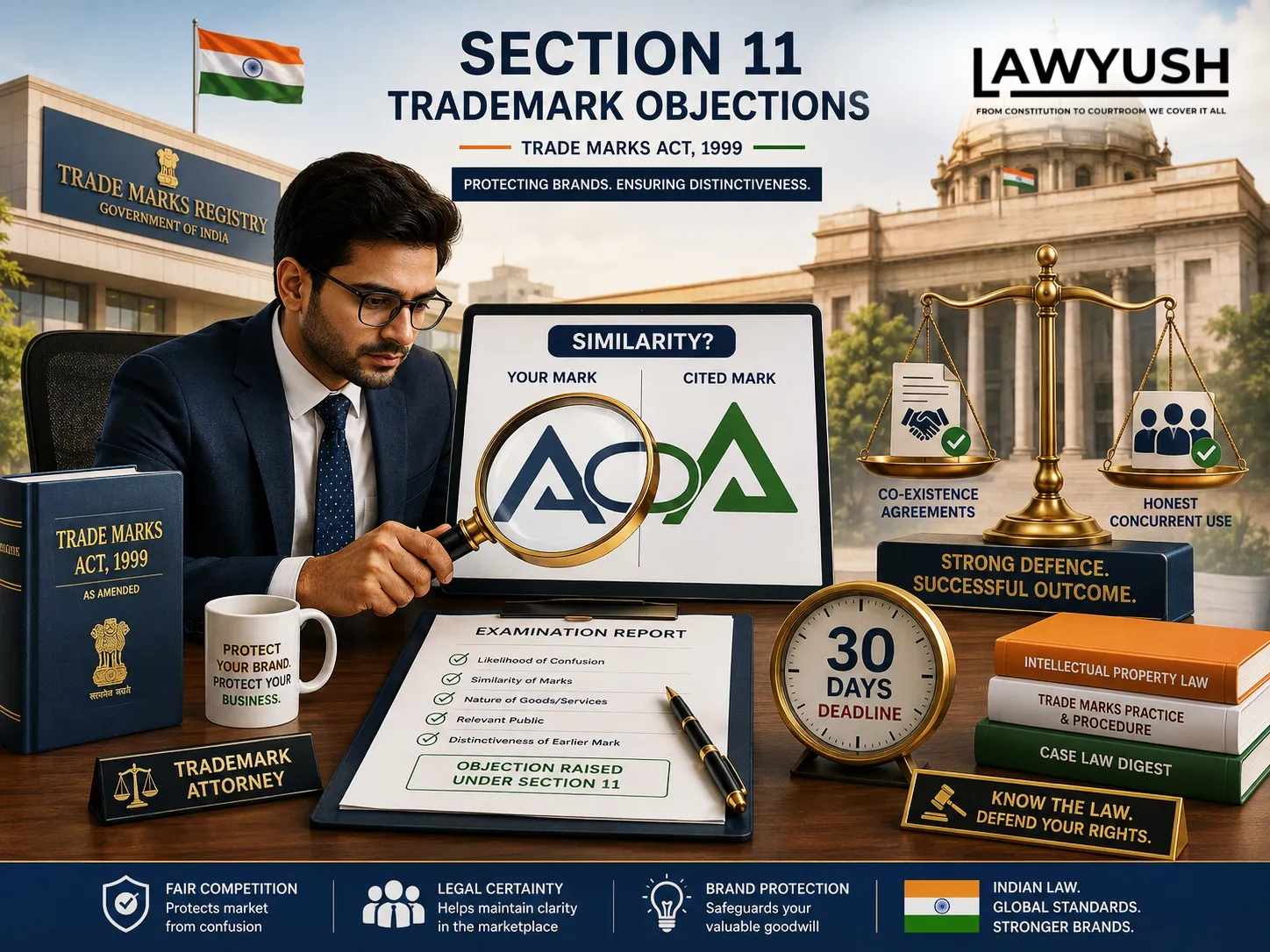
What Is a Section 11 Trademark Objection?
You finally did it. You picked a name, designed a logo, and filed your trademark application. For a few weeks, you allowed yourself to relax. Then the email lands: “Examination Report Issued.” You open the PDF, scroll past the polite formatting, and there it is: a Section 11 trademark objection, citing three, four, sometimes ten “similar” marks you’ve never even heard of.
Your stomach drops. Is your brand name dead? Do you need to rebrand, reprint your packaging, and start over?
Take a breath. You do not. An objection is not a rejection. It is the Trade Marks Registry doing its job, flagging a potential conflict and giving you a chance to explain why your mark deserves to coexist. Thousands of applications receive a Section 11 trademark objection every month, and a large number of them go on to register successfully.
This post walks you through exactly what a Section 11 trademark objection means, why you got flagged, and most importantly, what to do next.
Section 9 vs. Section 11: Know the Difference
Before we get to the objection, it helps to understand what the Registrar is actually checking. When you file a trademark application in India, it doesn’t get a rubber stamp. It goes through examination, where an Examiner checks your mark against two broad categories:
- Absolute grounds (Section 9): Is your mark inherently registrable? Is it distinctive, or is it just a generic/descriptive word anyone should be free to use?
- Relative grounds (Section 11): Does your mark clash with someone else’s earlier trademark?
Think of it this way: Section 9 asks “does this mark deserve protection at all?” Section 11 asks “does this mark step on someone else’s toes?” Two completely different questions — and mixing them up is one of the most common points of confusion for founders (more on this in the FAQs).
Grounds for a Section 11 Trademark Objection
Section 11 of the Trade Marks Act, 1999 deals with relative grounds of refusal, meaning your mark is compared against marks that are already on the register or pending with an earlier filing date.
Section 11(1)(a): Identical Mark + Identical/Similar Goods
This clause applies when your mark is identical to an earlier mark, used for identical or similar goods/services, creating a likelihood of confusion.
Plain English example: You want to register “ZENITH” for laptops, and someone already owns “ZENITH” for laptops. That’s a direct hit under clause (a): same mark, same category.
Section 11(1)(b): Similar Mark + Identical/Similar Goods
This clause is broader. It applies when your mark is similar (not identical) to an earlier mark, used on similar or identical goods, such that there’s a likelihood of confusion, including an association with the earlier mark.
Plain English example: You apply for “ZENYTH” (spelled differently, sounds almost the same) for laptops. Even though it’s not an exact copy, the phonetic similarity combined with the identical product category can trigger a Section 11 trademark objection under clause (b).
| Aspect | Clause (a) | Clause (b) |
|---|---|---|
| Mark comparison | Identical marks | Identical or similar marks |
| Goods/services | Identical or similar | Identical or similar |
| Confusion requirement | Presumed (near-automatic) | Must be shown/assessed |
Key takeaway: Clause (a) objections are harder to argue around because the marks match exactly; your defense will usually hinge on differences in goods, trade channels, or consent. Clause (b) objections leave more room to argue, because “similarity” is a matter of degree, not a binary fact.
Section 11(2): Well-Known Marks
Section 11(2) protects well-known marks even across different classes of goods or services. This is why a small, unrelated business can still receive a Section 11 trademark objection for choosing a name that resembles a globally recognized brand. Well-known marks get an extra layer of protection precisely because their reputation transcends categories.
How to Overcome a Section 11 Trademark Objection
This is where strategy comes in. A well-drafted reply can turn a scary objection into a successful registration. Here are the core defense strategies IP professionals actually use:
- Phonetic, visual, and conceptual dissimilarity: Argue that despite superficial resemblance, the marks sound different, look different, or mean different things to an average consumer. Courts have consistently held that marks must be compared as a whole, not letter-by-letter.
- Difference in goods/services and trade channels: If the cited mark is registered for, say, industrial machinery, and yours is for organic skincare, argue that the consumer base, price point, and purchase behavior are entirely different, reducing any real chance of confusion.
- Honest and concurrent use (Section 12): If you’ve been using your mark honestly, in good faith, for a substantial period even without registration, you may claim protection under Section 12, which allows the Registrar to permit registration of similar or identical marks by more than one proprietor where honest concurrent use is established.
- Consent or co-existence agreements: If you can reach the owner of the cited mark and obtain a No Objection Certificate (NOC) or a formal co-existence agreement, this carries significant weight with the Examiner and often resolves the objection outright.
- Section 20(1) proviso, advertisement before acceptance: In certain cases, the Registrar can allow an application to be advertised before final acceptance, giving the applicant a chance to demonstrate distinctiveness through actual market use, subject to conditions.
- Distinguishing the prior mark’s actual use or status: Sometimes the cited mark is abandoned, not renewed, or not actually in use. Checking the current status of cited marks on the IP India public search portal is a critical, often-overlooked first step.
The 30-Day Deadline: Don’t Miss This
Once your Examination Report is uploaded on the IP India portal, you generally have 30 days from the date of the report to file your reply. This is a strict, non-negotiable clock. Missing it can result in your application being treated as abandoned, meaning you lose your priority date and effectively have to start from scratch.
Set a calendar reminder the day you see that report. Don’t wait for a “final notice”; for many applicants, there isn’t one.
Step-by-Step Roadmap: Day 1 to Show-Cause Hearing
- Day 1-3: Read the Examination Report carefully. Identify whether the objection is under Section 9, 11(1)(a), 11(1)(b), or 11(2), and note every cited mark and its application/registration number.
- Day 4-7: Pull the current status of each cited mark from the IP India public search. Check if it’s registered, opposed, abandoned, or expired.
- Day 8-15: Build your defense. Draft your phonetic/visual/conceptual comparison, gather evidence of prior use (invoices, packaging, social media dates, website archives), and explore consent from the cited proprietor if feasible.
- Day 16-25: Draft the formal reply with legal grounds, supporting case law, and evidence annexures. This is best done with a qualified IP professional, since drafting quality genuinely affects outcomes.
- Day 26-30: File the reply on the IP India portal before the deadline. Keep the acknowledgment.
- Post-filing: If the Examiner isn’t satisfied, a Show-Cause Hearing is scheduled; your chance to argue in person (or via video conferencing) before the Registrar and present your evidence.
- If refused: You can file an appeal.
Appeal Under Section 91
If your application is refused even after the hearing, all is not lost. Section 91 allows an aggrieved applicant to file an appeal before the High Court (appellate jurisdiction over trademark matters was transferred to High Courts after the abolition of the IPAB in 2021) within the prescribed period from the date of the Registrar’s order. It’s a further, meaningful avenue, not the end of the road.
Judicial Precedents on Section 11
Understanding how courts have actually applied a Section 11 trademark objection makes the legal principles much easier to grasp.
Modicare Limited vs. Registrar of Trade Marks (2022)
Facts: Modicare Limited’s trademark application faced objection and refusal on grounds of similarity with cited marks under Section 11, and the applicant challenged the Registrar’s order.
Issue: Whether the Registrar’s assessment of similarity and likelihood of confusion was legally sound, and whether the reasoning met the standard required for a refusal order.
Judgment: The court reinforced that refusal orders under Section 11 must reflect genuine application of mind to factors like overall similarity and consumer perception, not a mechanical listing of cited marks.
Corn Products Refining Co. vs. Shangrila Food Products Ltd. (1959)
Facts: This landmark Supreme Court case involved a dispute over “GLUVITA” (for glucose/food products) resembling the earlier “GLUCOVITA.”
Issue: Whether marks should be compared for similarity as a whole, or dissected into individual components.
Judgment: The Supreme Court held that marks must be judged by their overall impression on an average consumer with imperfect recollection, not through a side-by-side, syllable-by-syllable dissection. This “anti-dissection” principle remains one of the foundational tests applied in Indian trademark similarity analysis today.
Cadila Healthcare Ltd. vs. Cadila Pharmaceuticals Ltd. (2001)
Facts: Two companies with a common corporate history both used marks resembling “FALCITAB” and “FALCIGO” for pharmaceutical products treating similar ailments.
Issue: What factors should courts weigh when assessing likelihood of confusion, especially for medicinal products where confusion could have serious consequences?
Judgment: The Supreme Court laid down a comprehensive, multi-factor test: the nature of the marks, degree of similarity, nature of goods, class of purchasers, and mode of purchase, and emphasized that a stricter standard applies to pharmaceutical products given the public health stakes. This case remains a go-to citation in nearly every Section 11 defense involving specialized or sensitive goods.
(You can read the full text of the Trade Marks Act, 1999 on the IP India website for the exact statutory language of Sections 9, 11, 12, 20, and 91.)
Conclusion
A Section 11 trademark objection can feel like your brand’s biggest setback, but in reality, it’s simply one more procedural step in a process designed to protect everyone’s trademarks, including, eventually, yours. With the right strategy genuine dissimilarity arguments, honest concurrent use, trade channel differentiation, or a straightforward consent letter most Section 11 objections are entirely surmountable within the 30-day window.
The single biggest mistake founders make isn’t losing the argument. It’s missing the deadline or filing a weak, generic reply without proper legal grounding.
If you’ve received a Section 11 trademark objection, don’t attempt a DIY reply based on a template you found online. Every case turns on its specific facts: the cited marks, your evidence of use, your goods description, and the strength of your comparative analysis.
FAQs
1. What is a trademark?
A trademark is a distinctive sign a word, logo, symbol, sound, or combination thereof used to identify and distinguish the goods or services of one business from those of others.
2. Who is the Registrar of Trademarks?
The Registrar of Trademarks is the statutory authority under the Trade Marks Act, 1999, responsible for examining, registering, and maintaining the Register of Trademarks in India, operating through the Trade Marks Registry offices under the Controller General of Patents, Designs and Trademarks (CGPDTM).
3. What is passing off of a trademark?
Passing off is a common law remedy (independent of registration) available when one party misrepresents their goods or services as those of another, damaging the goodwill of the genuine proprietor. It protects unregistered marks based on reputation and prior use.
4. What are the different types of trademarks?
Trademarks can include word marks, logo/device marks, combination marks, service marks, collective marks, certification marks, shape marks, sound marks, and even non-conventional marks like scent or color marks (subject to distinctiveness).
5. How do I register a trademark in India?
The process broadly involves: conducting a trademark search, filing the application (Form TM-A) with the appropriate class and specification of goods/services, examination by the Registry, publication in the Trade Marks Journal, the opposition period (if any), and finally registration and issuance of the certificate.
6. What is the difference between Section 9 and Section 11?
Section 9 deals with absolute grounds of refusal — whether the mark itself is inherently distinctive or falls into a prohibited category (generic, descriptive, or deceptive). Section 11 deals with relative grounds — whether the mark conflicts with an earlier trademark already on record. Simply put: Section 9 looks inward at your mark; Section 11 looks outward at everyone else’s.
Disclaimer: This blog post is for general informational purposes only and does not constitute formal legal advice. Please consult a qualified trademark attorney or IP professional regarding your specific application and objection.
Read More:
Cybercrime Complaint Filing in India: The Complete cybercrime.gov.in Guide (2026)
Police Identification During Protests: Accountability, Law & Citizen Rights
RTI Act 2005: The Complete Citizen’s Guide to Filing, First Appeal & Second Appeal
e-FIR & Zero FIR Under BNSS 2023: The Complete Guide to Filing, Tracking & Escalating