Your Late-Night Chat With AI Might Not Be as Private as You Think
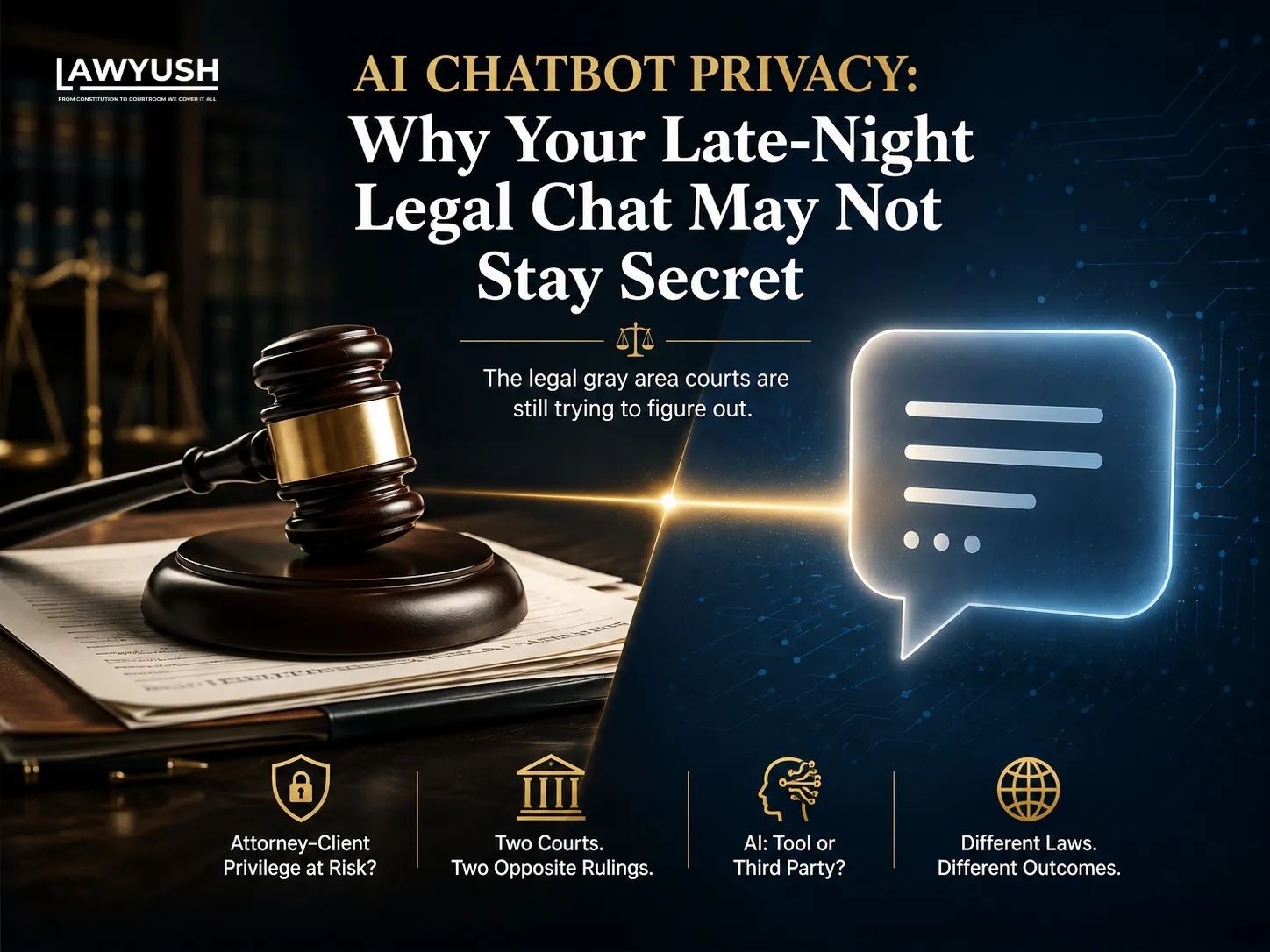
AI chatbot privacy is no longer a theoretical debate; it’s now a live legal question deciding what shows up as evidence in court.
Picture this: you’re anxious about a legal problem, it’s 1 a.m., and your lawyer isn’t picking up. So you open an AI chatbot and start typing – laying out your side of the story and working through your defense before your next conversation with counsel. Feels private, right? Just you and a chatbot.
A federal court in New York recently said not so fast. A federal court in Michigan, ruling on a nearly identical situation, said the opposite. Same basic scenario, two completely different outcomes.
Buried in that contradiction is a question that affects millions of people who now use AI as a thinking partner: when you type something into a chatbot, are you talking to a tool, or to a stranger who happens to be listening in?
The Case That Put AI Chatbot Privacy on Trial
In February 2026, a man named Bradley Heppner, facing securities fraud charges, was ordered by a New York court to hand over notes he’d drafted using an AI chatbot. He’d written them in anticipation of his own arrest and had shared them with his lawyer beforehand.
His argument seemed reasonable. These were preparation notes based on advice from his attorney, so they should be shielded by attorney-client privilege, the legal principle that protects private conversations between a client and their lawyer.
The court disagreed. Its reasoning: the AI company’s privacy policy allowed user conversations to be collected, used for training, and shared with third parties. Because the door was technically open, the court said, there was no real expectation of privacy.
Two Courts, Two Rulings on AI Chatbot Privacy
A different court, hearing a case involving a woman who used a different AI chatbot to help prepare her legal case, reached the opposite conclusion.
That court’s logic was refreshingly simple: an AI program is a tool, not a person. It doesn’t “receive” your confidential thoughts the way a human third party would; it just processes what you already knew and put into words. Since a tool can’t be an adversary, using it doesn’t hand your legal strategy over to anyone.
Same basic fact pattern. Opposite verdicts. That’s a problem and not just for people already in legal trouble.
Is Your AI Chatbot a Tool or a Third Party?
This is the real crux of the AI chatbot privacy debate, and it matters more than most people realize.
- If AI counts as a third party: every time you use a chatbot to think through a personal or legal problem, you could be waiving your right to keep that thinking confidential even before you’ve spoken to a lawyer.
- If AI counts as a tool: chatting with AI is no different from typing your thoughts into a Word document or a notes app. It’s just you, thinking out loud, in a slightly more interactive format.
Here’s why the “third party” framing doesn’t hold up under scrutiny.
A Privacy Policy Is a Poor Test for AI Chatbot Privacy
The New York court leaned heavily on the company’s privacy policy to decide there was no expectation of privacy. But think about how privacy policies actually work:
- They get updated multiple times a year, often with little fanfare.
- Almost nobody reads them in full, let alone fully understands them.
- A conversation you had in January could, in theory, become “discoverable” in June — not because you did anything differently, but because a company quietly rewrote its terms.
Basing a fundamental legal protection on a document that changes on the company’s schedule, not the user’s, is a shaky foundation.
There’s actually a much older and better legal test for this exact problem: the “reasonable expectation of privacy” standard, first laid out by the U.S. Supreme Court decades ago in Katz v. United States, a case about a public phone booth. That ruling established that just because eavesdropping is technically possible, that doesn’t mean your expectation of privacy disappears. The New York court seems to have skipped right past that principle, and it didn’t even confirm which privacy settings the user had actually chosen.
Digital Tools Don’t Usually Break Confidentiality
Think about how much of your confidential work already lives on third-party platforms. You draft sensitive documents in cloud-based word processors. You store case files on cloud servers. You message colleagues about strategy on workplace chat apps.
All of these platforms are technically capable of being compelled to hand over data under a court order, yet the underlying conversations aren’t automatically treated as “leaked” just because a tech company’s servers touched them. That’s because these platforms act as a conduit, not a conversational participant.
Courts have long applied similar logic to human helpers, too. An accountant who helps translate complicated numbers into something a lawyer can use doesn’t blow up privilege, because they’re supporting the legal process, not intruding on it. An AI chatbot organizing your thoughts for your lawyer arguably plays the exact same supporting role.
Preparing to Talk to a Lawyer Isn’t Replacing One
Here’s where the New York ruling gets a little strange. It focused heavily on the fact that the AI chatbot displayed a disclaimer saying it couldn’t give legal advice, and used that to conclude the user couldn’t have intended a privileged interaction.
But that disclaimer exists to protect the company from claims of practicing law without a license. It has nothing to do with whether you were allowed to think through your own case before calling your actual attorney.
There’s a meaningful difference between:
- Using AI instead of a lawyer, and
- Using AI to prepare for a conversation with your lawyer.
Heppner did the latter. He used information from his attorney, worked through his thinking, and then shared the output with his legal team. That’s basic trial prep, whether it happens on a legal pad or inside a chat window.
AI Chatbot Privacy Laws Differ Around the World
This isn’t just an American puzzle. Different countries are handling AI chatbot privacy in strikingly different ways.
In India, privilege law is drawn narrowly, generally covering only direct communications with an advocate or their clerks. There’s no broad protection for materials prepared independently in anticipation of a case, which means if courts decide an AI chatbot counts as an outside third party, the protection could disappear entirely. This is a real gap that current draft AI regulations for courts don’t address.
In Canada and the UK, the standard is more forgiving. As long as the purpose of the material was preparing for anticipated litigation, it stays protected, regardless of whether a third party technically had access to it. Under this approach, an AI company’s ability to access your data wouldn’t automatically strip away your protection.
The takeaway: where you live may already determine how safe your AI conversations are, long before any court weighs in on the specific question of chatbots.
Key Takeaways on AI Chatbot Privacy
- Two U.S. courts reached two opposite rulings; one said using AI to prep for a legal case waived privilege, the other said it didn’t.
- Privacy policies are a poor legal test because they change often and few people read them closely.
- A stronger standard already exists: whether you had a genuine, reasonable expectation of privacy, not whether access was theoretically possible.
- AI tools that help you organize your thoughts function more like a digital notepad or a supporting service than an outside party to your legal strategy.
- Disclaimers saying “this isn’t legal advice” protect the AI company from liability; they don’t determine whether your own thinking stays private.
- Protections vary by country, with Canada and the UK favoring the user’s purpose, and India currently offering the thinnest safety net.
- Until courts settle on a consistent standard, identical situations will keep producing opposite legal outcomes.
Where Does This Leave You?
Until lawmakers or higher courts step in with a clear answer, there’s no universal rulebook for how private your AI conversations really are. What’s protected in one courtroom might be fair game in another, and the difference could come down to which judge you draw.
So here’s the question worth sitting with: if a court could someday read your AI chat history word for word, would you still send that message?
If this made you rethink how you use AI for anything sensitive, share it with someone who should see it. And drop your take in the comments: should AI chatbots be treated as a tool, or as a third party listening in?
FAQs on AI Chatbot Privacy
1. Is AI chatbot privacy protected by attorney-client privilege? It depends on the court. Some judges treat AI chatbots as tools that don’t break privilege; others treat them as third parties whose privacy policies can waive it.
2. Can my AI chat history be used as evidence in court? Yes, it’s possible. Courts have already ordered AI chat logs to be produced in litigation, so treat anything typed into a chatbot as potentially discoverable.
3. Does India recognize attorney-client privilege for AI chatbot conversations? Indian privilege law is narrow and generally limited to direct communications with an advocate, so AI chatbot conversations currently sit in a legal gray area.
Read More:
Cybercrime Complaint Filing in India: The Complete cybercrime.gov.in Guide (2026)
Police Identification During Protests: Accountability, Law & Citizen Rights
RTI Act 2005: The Complete Citizen’s Guide to Filing, First Appeal & Second Appeal
e-FIR & Zero FIR Under BNSS 2023: The Complete Guide to Filing, Tracking & Escalating