
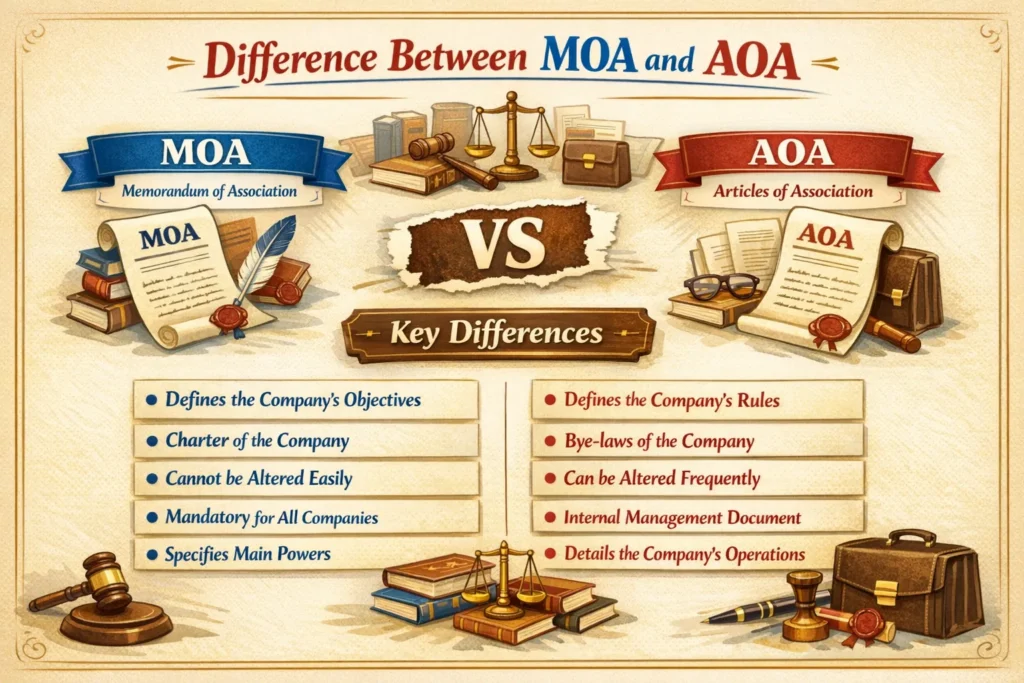
One of the most common and basic questions in Company Law is the difference between MOA and AOA. You are a law student or a company secretary aspirant, an entrepreneur or a legal professional, you need to get to know the difference between MOA and AOA not only to grasp the difference theoretically, but practically as well.
The constitutional documents of a company constitute MOA and AOA. Nevertheless, they are completely different in their nature, scope, purpose and legal impact. The article describes the distinction of MOA and AOA in a well-elaborated, but simple to understand form, so that it can be used in both blogs and examinations.
Definition of MOA (Memorandum of Association)
To have a clear view of the difference between MOA and AOA, one has to know what MOA is.
The most important and highest document of a company is a Memorandum of Association (MOA). It stipulates the goals, limits of operations, and authority of the firm. MOA forms a connection between the company and the external world.
Simply put, MOA provides the answer to the question:
What is legally the company doing?
Any duty undertaken outside the MOA is ultra vires (beyond authority) and it goes against the law.
Meaning of Articles of Association (AOA)
In order to get the difference between MOA and AOA, we shall now consider AOA.
The articles of association (AOA) are the internal rules and regulations that are used to manage and administer the company. AOA determines the type of operation that the company will have.
Simply put, AOA provides the answer to the question:
“How will the company operate?”
AOA controls issues including appointment of directors, meetings, making and transfer of shares, policy on dividends and internal governance.
Basic Difference between MOA and AOA.
The difference between MOA and AOA is in the purpose and authority.
- MOA provides the external boundaries of the operations of a company.
- The internal management is regulated by AOA within those limits.
The charter of the company is MOA and the rulebook is AOA.
Difference Between MOA and AOA
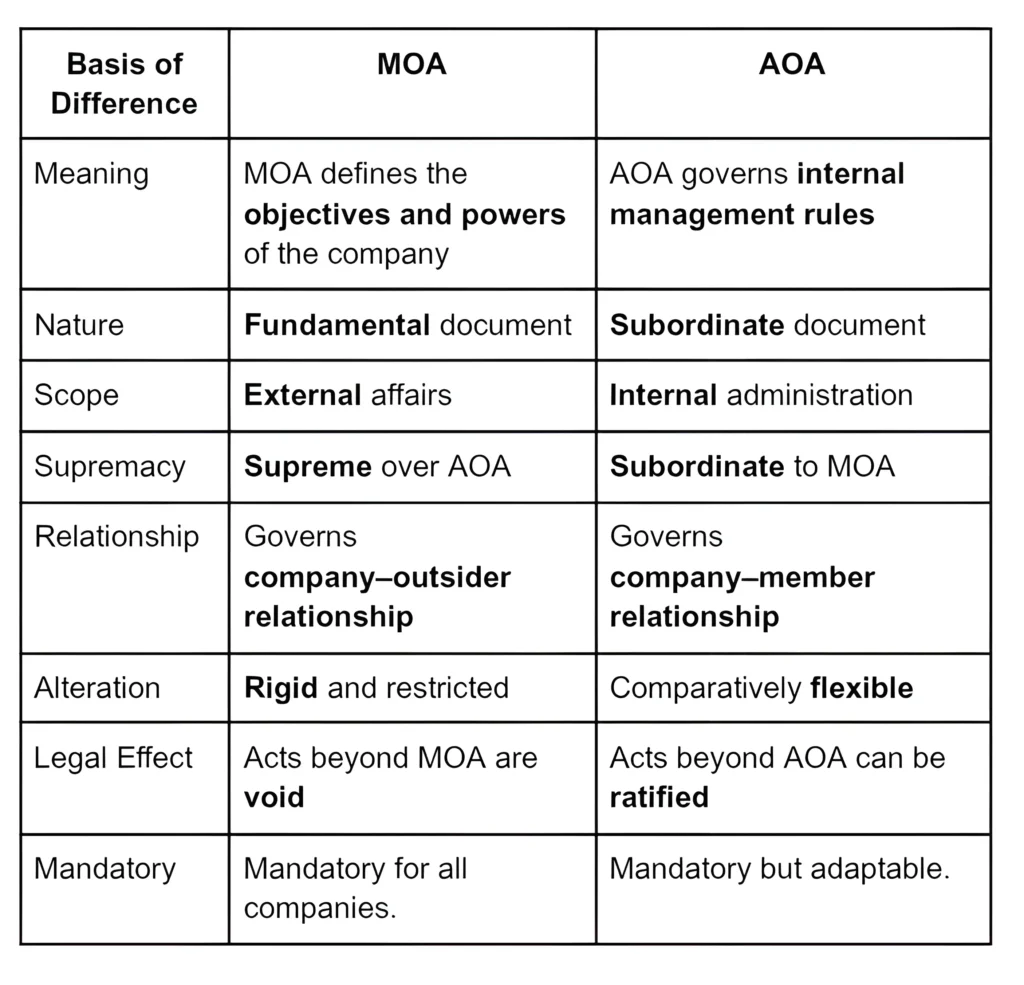
Difference Between MOA and AOA under Legal Authority.
Legal authority is one of the most significant factors of the difference between MOA and AOA.
MOA – Supreme Authority
The highest authority document of the company is MOA. It establishes limits within which an organization should be dealing. The shareholders too cannot sanction a step exceeding MOA.
AOA – Subordinate Authority
AOA is subordinate to MOA. It may not have such inconsistent provisions with the MOA or Companies Act.
In case there arises any conflict, MOA takes precedence over AOA.
Difference Between MOA and AOA in Terms of Alteration
The other distinction between MOA and AOA is the alteration process.
Alteration of MOA
- Majority needs a special resolution.
- At liberty to statutory limitations.
- Frequently needs permission of authorities.
- More rigid process
Alteration of AOA
- Does not pass without a special resolution.
- Less restrictive
- In the majority of cases, no external approval.
- More flexible
In this way, MOA can be modified relatively more easily, compared to AOA, which is more flexible.
Difference Between MOA and AOA and Doctrine of Ultra Vires
The other difference between MOA and AOA is explained in the doctrine of ultra vires.
- The acts which are not consistent with MOA are invalid and they cannot be ratified.
- Shareholders can ratify acts that are not within AOA but within MOA.
This indicates that MOA has unconditional restrictions whereas AOA has internal adjustments.
Difference Between MOA and AOA in Practical Application
The distinction between MOA and AOA is important in the field of a real-life corporation.
Practical Role of MOA
- Guarantees shareholders and creditors.
- Helps in avoiding abuse of corporate funds.
- Establishes authorized business practices.
Practical Role of AOA
- Controls domestic policies.
- Avoids internal disputes.
- Facilitates proper running of management.
In this way, both documents have similar but opposite functions.
Difference Between MOA and AOA for Law Exams
According to examination, MOA and AOA are high-weightage topics.
How to Write in Exams:
- Begin with a definition of MOA and AOA.
- describe their nature and extent.
- Draw a comparative table
- Talk of doctrine of ultra vires.
- Sum up with their significance.
They can obtain maximum marks by making use of structured points and table.
Similarities between MOA and AOA.
Despite the fact that this article is about the difference between MOA and AOA, a slight mention of similarities gives some depth:
- The two are both statutory documents.
- They are both necessary during incorporation.
- Both commit the company and the members.
- They both are required to adhere to the Companies Act.
Talking about similarities enhances the performance during exams.
Importance of Understanding the Difference Between MOA and AOA
It is important to know the difference between MOA and AOA since they are different in the sense that:
- It ensures legal compliance
- It assists in decision making in corporations.
- It prevents ultra vires acts
- It safeguards the interests of the stakeholders.
In the case of entrepreneurs, it determines the freedom of business.
In the case of lawyers, it lays the foundation of the corporate litigation.
It is a conceptual subject of core to students.
Conclusion
The difference between MOA and AOA is at the core of the Company Law. MOA is a root that spells the missions and authorities of the company, whereas AOA regulates internal management and administration of the company.
MOA is absolute and uncompromising, and AOA is adaptable and subordinate. Both documents collaborate in order to provide legality, transparency and good corporate governance. Having good awareness of the distinction between MOA and AOA is a key to academic achievement, practice, and legal operation of corporations.
Follow us on Instagram, Youtube, Lawyush.
Frequently Asked Questions (FAQs)
What is the difference between MOA and AOA?
The difference between MOA and AOA is that MOA defines the objectives and external scope of a company, while AOA governs the internal management and administration.
Which document is supreme: MOA or AOA?
MOA is the supreme document of the company. AOA is subordinate to MOA and cannot override its provisions.
Can acts beyond MOA and AOA be ratified?
Acts beyond MOA are void and cannot be ratified, whereas acts beyond AOA but within MOA can be ratified by shareholders.
Which is easier to alter: MOA or AOA?
AOA is easier to alter compared to MOA. Alteration of MOA is more rigid and subject to statutory restrictions.
Why is the difference between MOA and AOA important?
Understanding the difference between MOA and AOA is important to ensure legal compliance, prevent ultra vires acts, and maintain proper corporate governance.