
The constitutional necessity of every firm established in India is the MOA and AOA under Companies Act 2013. You need to know MOA and AOA, whether you are a law student, company secretary aspirant, business start-up owner or compliance professional and the knowledge is important because you need to know the law as well as how to apply it.
The scope, powers, objectives, as well as the management of a company are outlined in the Memorandum of Association (MOA) and Articles of Association (AOA). Both the documents are important in the regulation of corporate functioning and safeguarding of stakeholders under the Companies Act, 2013.
This Article describes the meaning of MOA and AOA, their characteristics, the difference between them, and their legal importance in a simple and easily searchable language of Companies Act 2013.
What is MOA according to the Companies Act 2013?
The main and the basic document of any company is the Memorandum of Association (MOA). The relationship of the company with the outside world is spelt out in the MOA under Companies Act of 2013.
The MOA states:
- Why the company is formed
- What business it can lawfully do.
- What are the boundaries of its powers.
Any other activity is ultra vires and void.
Clauses of MOA Under Companies Act 2013
The MOA has the following clause:
- Name Clause- The name of the company in legal terms.
- Registered Office Clause– Refers to the state in which the registered office of the company is located.
- Object Clause -This establishes the main and ancillary objects of the company.
- Liability Clause- It states the limit or the unlimited liability of members.
- Capital Clause- Refers to the authorized share capital.
- Subscription Clause- This has the purpose of subscribers to establish the company.
When referring to MOA and AOA as companies Act 2013, the object clause plays the greatest role, as it will decide whether the company will be operating in accordance with the law.
What are AOA under Companies Act 2013?
The internal rules and regulations are known as the Articles of Association (AOA), which govern the company. MOA prescribes the boundaries, whereas AOA interprets how the company will be running within the boundaries.
AOA governs: under MOA and AOA under Companies Act 2013:
- Share issue and transfer
- Powers of directors
- Conduct of meetings
- Dividend distribution
- Internal administration
AOA serves as a guide book in day to day corporate governance.
Relationship Between MOA and AOA.
The MOA- AOA relationship under companies act 2013 is in the form of hierarchy.
- MOA is the supreme document
- AOA is subordinate to MOA
- AOA should never contradict MOA.
- In the event of any disagreement, MOA wins.
Therefore, AOA (can not) usurp or broaden the scope spelt out in MOA.
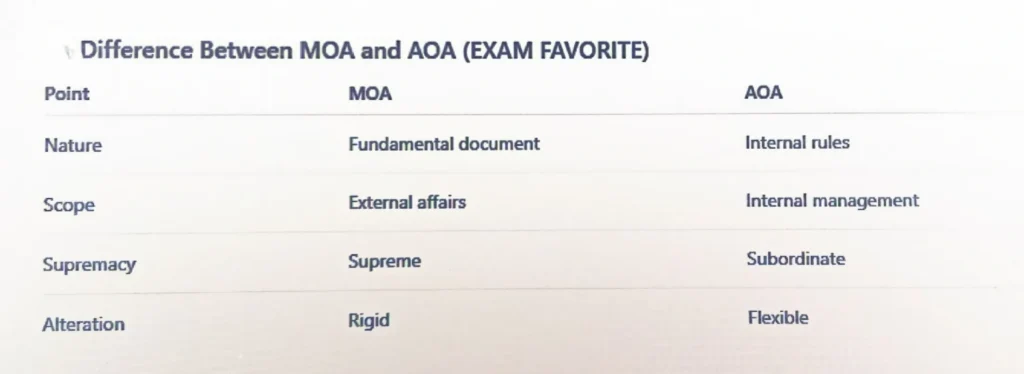
Difference Between MOA and AOA under Companies Act 2013
Legal Significance of MOA and AOA in Companies Act 2013
MOA and AOA have legal significance under Companies Act 2013 that can hardly be overestimated.
Importance of MOA
- Essentially identifies the legal capability of the company.
- Guarantees stockholders and lenders.
- Avoids abuse of corporate authorities.
Importance of AOA
- Provides efficient in house operations.
- Lays down rights of members and responsibilities.
- Assist in the settling of internal disputes.
The binding effectiveness of MOA has always been solidified by the limited jurisdiction of courts stating that acts outside MOA are void.
Doctrine of Ultra Vires and MOA.
The ultra vires doctrine is closely related to MOA and AOA under Companies Act 2013. Any action that has been taken outside the object clause of the MOA is ultra vires and is also void even when it is sanctioned by the shareholders.
This doctrine protects investors and guarantees corporate discipline.
Alteration of MOA and AOA
Alteration of MOA
- Specific resolution is required.
- At this, it is subject to legal limitations.
- More rigid process
Alteration of AOA
- Alterable by special resolution.
- Should not be contrary to MOA or law.
This flexibility indicates that MOA and AOA are dynamic as per the Companies Act 2013.
Under Companies Act 2013: Practical Relevance of MOA and AOA.
To entrepreneurs, MOA and AOA dictate freedom of business.
In the case of lawyers, they constitute corporate litigation.
To students, they are heavyweight examination subjects.
Therefore, understanding MOA and AOA under Companies Act 2013 under both academic and professional point of view is a necessity.
Conclusion
The legal basis of the existence and operation of the company is the MOA and AOA of the Companies Act 2013. MOA provides parameters of corporate power, whereas AOA manages internal management.
Correct interpretation of MOA and AOA will bring out compliance, transparency, and good corporate governance. It is a requirement in the Indian company law that whether it is to write an exam, in practice or to form a business, such documents are very essential.
Follow us on Instagram.
Subscribe on Youtube
Frequently Asked Questions (FAQs)
What is MOA under Companies Act 2013?
MOA under Companies Act 2013 refers to the Memorandum of Association, which defines the objectives, scope, and powers of a company. It acts as the charter document and limits corporate activities.
What is AOA under Companies Act 2013?
AOA under Companies Act 2013 means Articles of Association, which regulate the internal management of the company, including rules related to directors, shareholders, and meetings.
What is the difference between MOA and AOA?
The main difference between MOA and AOA is that MOA defines the external scope and objectives of a company, whereas AOA governs its internal administration and management.
Can MOA and AOA be altered under Companies Act 2013?
Yes, both MOA and AOA under Companies Act 2013 can be altered by passing a special resolution, subject to statutory restrictions and approvals.
Why are MOA and AOA important?
MOA and AOA under Companies Act 2013 are important because they define company powers, protect shareholders and creditors, and ensure lawful corporate governance.