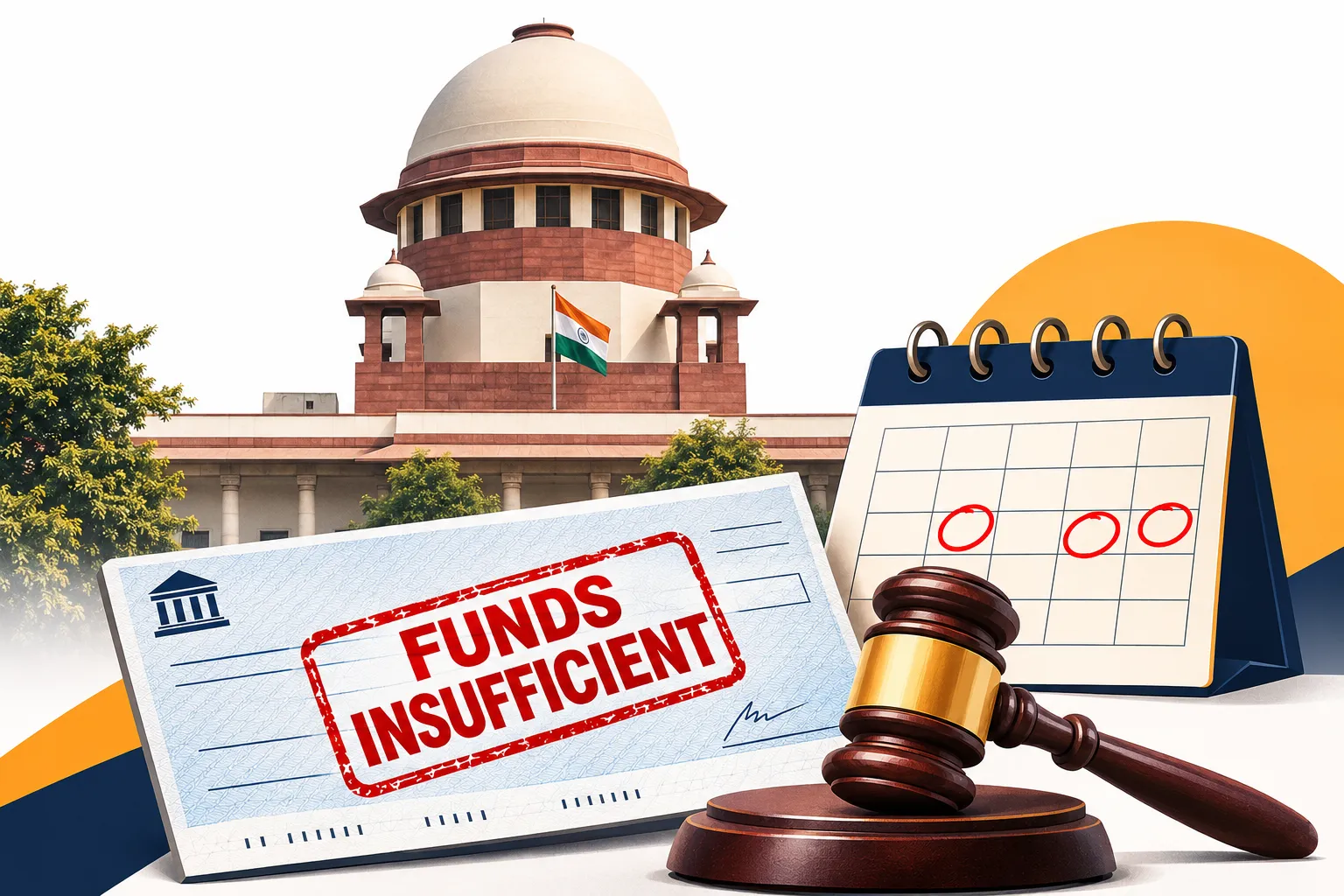
Most people discover a bounced cheque in the least dramatic way possible: an SMS from the bank, or a return slip with a red stamp. What they do in the next four weeks decides whether they recover the money or lose their legal remedy for good.
Section 138 is one of the most litigated provisions in India. It is also one of the most technical. Courts regularly throw out complaints, not because the debt was fake, but because a notice went out a day late or the wrong person was named as accused. This guide walks through the law as it stands in November 2026, including the Supreme Court’s September 2025 directions that changed how these cases are run.
Table of Contents
- What is a cheque bounce case?
- Legal framework for a cheque bounce case at a glance
- Five ingredients of a cheque bounce case
- Deadlines you cannot miss
- Step-by-step guide for the payee
- How to draft the legal notice
- Filing the complaint: court, jurisdiction, documents
- How the trial works
- Punishment, appeal and the 20% deposit
- Settlement and compounding
- Defences available to the drawer
- Company cheques and directors
- Important judgments
- Myths vs facts
- Common mistakes
- Frequently asked questions
- Conclusion and key takeaways
What is a cheque bounce case?
“Cheque bounce” is everyday language. The law calls it dishonour of cheque. It happens when the bank returns a cheque unpaid, most often because the drawer’s account does not have enough money, or because the amount exceeds what the bank agreed to pay on that account.
Not every bounced cheque is a crime. A cheque that bounces because of a mismatched signature or a technical defect does not automatically attract Section 138. The offence is created only when the cheque was given to discharge a legally enforceable debt or liability and the drawer then fails to pay after a proper notice.
Why did Parliament make this a criminal matter? Because commerce in India runs on trust in cheques. If a cheque carries no consequence when it fails, it stops being a reliable substitute for cash. Section 138 was inserted in 1988 to protect that trust, and the Supreme Court has repeated that its purpose is more about securing payment than punishing the drawer.
Legal framework for a cheque bounce case at a glance
The law sits in the Negotiable Instruments Act, 1881 (the “NI Act”), read with the procedural code. Since 1 July 2024, the Bharatiya Nagarik Suraksha Sanhita, 2023 (BNSS) has replaced the CrPC, so older articles that mention CrPC sections need translating. The Supreme Court itself now cites both side by side.
| Provision | What it does |
|---|---|
| Section 138 | Creates the offence and fixes the punishment |
| Section 139 | Presumption that the cheque was issued for a debt or liability |
| Section 118 | Presumption of consideration for negotiable instruments |
| Section 140 | No defence that the drawer did not expect the cheque to bounce |
| Section 141 | Liability of companies and the persons in charge |
| Section 142 | Who can complain, time limit, and territorial jurisdiction |
| Section 143 | Summary trial; aim to finish within six months |
| Section 143A | Interim compensation up to 20% of the cheque amount |
| Section 145 and 146 | Evidence on affidavit; bank’s return memo is prima facie proof of dishonour |
| Section 147 | Every offence under the Act is compoundable |
| Section 148 | Appellate court may require deposit of at least 20% of the fine or compensation |
CrPC to BNSS pointers: the questioning stage of Section 251 CrPC is now Section 274 BNSS, the plea-of-guilty route in Section 255 CrPC is Section 278 BNSS, and the cognizance provision for complaints is Section 223 BNSS. You can read the Act itself on India Code.
Five ingredients of a cheque bounce case
A complaint survives only if each of these is present and provable.
- A cheque drawn on the drawer’s own account with a bank, in favour of another person.
- A legally enforceable debt or liability, whole or part, for which the cheque was given.
- Presentation within validity. Three months from the date on the cheque, or its validity period if shorter.
- Dishonour for insufficiency of funds or because the amount exceeds the arrangement with the bank. The Supreme Court has also treated “payment stopped by drawer” as covered, in Modi Cements Ltd. v. Kuchil Kumar Nandi (1998) 3 SCC 249.
- Failure to pay within 15 days after receiving a proper demand notice.
Notice what is absent: intention. Section 140 says the drawer cannot escape by claiming they did not know the cheque would bounce.
Cheque bounce case deadlines you cannot miss
Three clocks run one after another. Courts apply them strictly, because the whole structure is statutory.
| Step | Deadline | Counted from |
|---|---|---|
| Present cheque to bank | Within 3 months (or validity) | Date written on the cheque |
| Send demand notice | Within 30 days | Date you receive information of dishonour from the bank |
| Drawer’s chance to pay | 15 days | Date the notice is received by the drawer |
| File complaint | Within 1 month | Date the 15-day period expires |
A worked example
Suppose your bank tells you on 12 March 2026 that the cheque has bounced. You must send the notice by 11 April at the latest. Say you send it on 20 March and the drawer receives it on 23 March. The drawer has until 7 April to pay. If nothing arrives, your cause of action begins on 8 April, and you should file by about 7 May. Do not run it to the last day. Courts can condone delay under Section 142(1) if you show sufficient cause, but you should never plan around that discretion.
Timeline in text
Cheque issued -> Presented (within 3 months) -> Bank returns cheque
   -> Notice sent (within 30 days of bank info)
   -> 15 days for drawer to pay
   -> Complaint filed (within 1 month after that)
   -> Cognizance -> Summons -> Trial -> Judgment
Can you present the same cheque again? Yes, as long as it is within validity. In MSR Leathers v. S. Palaniappan (2013) 1 SCC 177, the Supreme Court allowed a fresh presentation and a fresh notice to create a fresh cause of action, with the one-month filing window running from that fresh default.
Step-by-step guide to start a cheque bounce case
- Collect the return memo. The bank’s memo states the reason for dishonour and the date. Under Section 146 it is prima facie proof.
- Calendar your dates immediately. Note the day you learned of dishonour. That starts the 30-day clock.
- Send a written demand notice to the drawer’s last known address, by speed post or registered post, and by email if you have it.
- Wait out the 15 days. Accept part-payment only with a written record of what it is for.
- Prepare the complaint and the synopsis in the format the Supreme Court now prescribes (explained below).
- File before the competent Magistrate within one month of the cause of action.
- Give verified contact details of the accused for service of summons.
How to draft the legal notice for a cheque bounce case
The notice is the hinge of the entire case. A defective notice is one of the commonest reasons complaints fail. It must:
- Be in writing and be addressed to the drawer (and, for company cheques, the company and the persons in charge).
- Identify the cheque by number, date, amount and bank.
- State that the cheque was returned unpaid and give the date and reason.
- Demand payment of the cheque amount specifically within 15 days of receipt.
- Be sent within the 30-day window.
Do not demand a vague “dues” figure that mixes the cheque amount with interest and damages without separating them. The statute speaks of “the said amount of money”, meaning the cheque amount. Many lawyers state the cheque amount clearly and add any interest claim as a separate line.
Service. In C.C. Alavi Haji v. Palapetty Muhammed (2007) 6 SCC 555, the Supreme Court held that a notice properly posted to the correct address is treated as served, and a drawer cannot defeat it by refusing to collect the envelope. The Court also said a drawer who claims non-receipt can still pay within 15 days of receiving the summons, failing which the defence is not available. Use a correct, complete address and keep the receipt.
Filing a cheque bounce case: court, jurisdiction, documents
Who can file and where
The payee, or the holder in due course, files a written complaint before a Magistrate of the First Class or a Metropolitan Magistrate. Territorial jurisdiction is governed by Section 142(2). If the cheque was deposited through the payee’s account, the court where that branch is located has jurisdiction. This came from the 2015 amendment, which responded to the Supreme Court’s ruling in Dashrath Rupsingh Rathod v. State of Maharashtra (2014) 9 SCC 129. In Bridgestone India Pvt. Ltd. v. Inderpal Singh (2016) 2 SCC 75, the Court applied the amended jurisdiction rule to pending complaints too.
Documents to attach
- Original cheque and the bank’s return memo
- Copy of the legal notice, postal receipts, tracking report and proof of delivery
- Reply to the notice, if any
- Documents showing the debt (invoice, agreement, loan record, bank statement, messages)
- Affidavit of the complainant, plus an authorisation letter if a representative files
The mandatory synopsis
Since the Supreme Court’s September 2025 judgment, every Section 138 complaint must carry a synopsis at the top of the file in a set format. It covers the parties (with company details and signatory names where relevant), cheque details, dishonour details, statutory notice particulars including dispatch date, tracking number and delivery proof, the cause of action and the jurisdiction invoked, whether any other Section 138 complaint is pending between the same parties, and whether interim compensation under Section 143A is sought. You must also give the accused’s email, mobile or WhatsApp details with an affidavit that they are correct, and file an affidavit of service. A false affidavit of service can attract action against the complainant.
How a cheque bounce case trial works
The Supreme Court held in 2025 that a Magistrate need not issue summons to the accused before taking cognizance of a Section 138 complaint, so the pre-cognizance hearing contemplated by Section 223 BNSS does not apply to these cases. After cognizance, summons go out. They may be served in the usual way, by the complainant personally (dasti), and electronically by email or messaging apps where rules permit.
Summary trial and early questions
Section 143 directs a summary trial. The court should record reasons before converting it into a regular summons trial. At the first stage the Magistrate may ask the accused direct questions under Section 274 BNSS: Is this your cheque? Is that your signature? Did you give it to the complainant? Did you owe a liability? If you deny liability, what is the defence (security cheque, loan repaid, cheque altered)? And do you wish to compound? The answers are recorded in the order sheet.
Presumptions that favour the complainant
Sections 118 and 139 presume that the cheque was issued for consideration and in discharge of a liability. In Rangappa v. Sri Mohan (2010) 11 SCC 441, the Supreme Court held that the Section 139 presumption includes the existence of a legally enforceable debt. The accused rebuts it on a preponderance of probabilities, which is a lower bar than proof beyond reasonable doubt. In Bir Singh v. Mukesh Kumar (2019) 4 SCC 197, the Court said that even if a cheque was signed blank and handed over voluntarily, the presumption operates.
Interim compensation
Section 143A lets the trial court direct the drawer to pay interim compensation of up to 20% of the cheque amount, at the stage the accused pleads not guilty or when charge is framed. Payment is due within 60 days, extendable by 30 more for sufficient cause. If the accused is eventually acquitted, the complainant must refund it with interest. The 2025 judgment directed courts to use this power at the earliest wherever appropriate.
Cheque bounce case punishment, appeal and the 20% deposit
On conviction, the drawer can be sentenced to imprisonment up to two years, a fine up to twice the cheque amount, or both. In summary trials the sentence is capped at one year of imprisonment. The court may also direct that the fine be paid as compensation to the complainant.
The offence is non-cognizable and bailable in the ordinary course, so police do not arrest on a Section 138 complaint. The accused is summoned, appears and furnishes a bond. A warrant follows only if they keep avoiding court.
If the drawer appeals against conviction, Section 148 lets the appellate court order a deposit of at least 20% of the fine or compensation. Any amount already paid under Section 143A counts towards it. The Supreme Court has said this deposit should ordinarily be directed. See Surinder Singh Deswal v. Virender Gandhi (2019) 11 SCC 341. Recent decisions also allow courts to extend benefit of the Probation of Offenders Act, 1958 in suitable cases, as the 2025 judgment noted.
Settlement and compounding
Section 147 makes every offence under the NI Act compoundable. In practice, most disputes end in settlement. The Supreme Court first laid out cost-based compounding guidelines in Damodar S. Prabhu v. Sayed Babalal H. (2010) 5 SCC 663, and in Meters and Instruments Pvt. Ltd. v. Kanchan Mehta (2018) 1 SCC 560 it stressed that an offer to pay at the first hearing should be taken seriously.
In Sanjabij Tari v. Kishore S. Borcar (2025 INSC 1158), decided on 25 September 2025, the Court modified those guidelines. It reasoned that backlogs are huge and interest rates have fallen. The updated costs for the accused are:
| Stage at which cheque amount is paid | Old guidelines (Damodar Prabhu) | Current guidelines (Sanjabij Tari) |
|---|---|---|
| Before defence evidence is recorded | No cost at first or second hearing; 10% later | Compounding without any cost or penalty |
| After defence evidence, before trial judgment | 10% of cheque amount | Additional 5% to the Legal Services Authority or other authority |
| Before Sessions Court or High Court | 15% | 7.5% |
| Before the Supreme Court | 20% | 10% |
The Court also directed every district court to set up a QR code or UPI link so an accused can pay the cheque amount at the very start, and summons must mention this option. If the complainant demands more than the cheque amount, the Magistrate may suggest that the accused plead guilty, so the court can impose sentence, or extend Probation of Offenders Act benefit. The directions were to be implemented by 1 November 2025.
Defences in a cheque bounce case available to the drawer.
An accused is not helpless, even with the presumptions against them. Common defences include:
- No legally enforceable debt, shown through cross-examination or documents. A bare denial rarely works.
- Cheque given as security with no crystallised liability on the cheque date. The Supreme Court in Sripati Singh v. State of Jharkhand (2021) held that a security cheque falls within Section 138 once the debt becomes due and payable, so this defence turns on the facts.
- Defective or late notice, or notice not demanding the cheque amount.
- Complaint filed out of time without an application for condonation.
- Wrong court or wrong parties, including failing to implead the company.
- Cheque not presented in time, or not dishonoured for a reason covered by Section 138.
- Insolvency moratorium. In P. Mohanraj v. Shah Brothers Ispat Pvt. Ltd. (2021) 6 SCC 258, the Court held that Section 138 proceedings against a corporate debtor are barred during an IBC moratorium, though directors’ liability is treated differently.
One defence has been firmly shut. In Sanjabij Tari, the Court held that a cash loan of ₹20,000 or more does not stop being a “legally enforceable debt” merely because it violates Section 269SS of the Income Tax Act. Tax non-compliance may have tax consequences, but it does not unmake the debt for Section 138.
Company cheques and directors
When a cheque is drawn on a company’s account, Section 141 makes the company, and those in charge of its business at the time, liable. The company must be arraigned as an accused. In Aneeta Hada v. Godfather Travels and Tours Pvt. Ltd. (2012) 5 SCC 661, the Supreme Court held that directors can be prosecuted under Section 141 only if the company is also an accused.
A bench of Justices Manoj Misra and Vijay Bishnoi applied this in a decision reported in August 2026. It quashed a complaint against a director and authorised signatory because the company was never made a party, and held that the High Court could not direct the trial court to add the company later. I could only verify the case through news reports at the time of writing. Check the title and citation in the judgment on the Supreme Court website before relying on it in a filing.
Important judgments
| Case | Citation | Why it matters |
|---|---|---|
| Sanjabij Tari v. Kishore S. Borcar (Manmohan and N.V. Anjaria, JJ., 25 Sept 2025) | 2025 INSC 1158; 2025 LiveLaw (SC) 952; Crl. A. No. 1755 of 2010 | Presumptions reaffirmed; Section 269SS breach no bar; new procedure and compounding costs |
| Rangappa v. Sri Mohan (SC) | (2010) 11 SCC 441 | Presumption covers existence of debt; standard to rebut is preponderance |
| Bir Singh v. Mukesh Kumar (SC) | (2019) 4 SCC 197 | Signed blank cheque still attracts presumption |
| Dashrath Rupsingh Rathod v. State of Maharashtra (SC) | (2014) 9 SCC 129 | Jurisdiction ruling later overridden by the 2015 amendment |
| Indian Bank Association v. Union of India (SC) | (2014) 5 SCC 590 | Directions on speedy trial of cheque cases |
| In Re: Expeditious Trial of Cases under Section 138 (SC) | (2021) 16 SCC 116 | Summary trial and reasons before conversion |
| Aneeta Hada v. Godfather Travels (SC) | (2012) 5 SCC 661 | Company must be an accused for director liability |
| Damodar S. Prabhu v. Sayed Babalal H. (SC) | (2010) 5 SCC 663 | First compounding guidelines |
Always read the primary text. For the 2025 judgment, see the judgment PDF, and for the older compounding rules the Damodar Prabhu judgment on Indian Kanoon. A law-reports copy of Sanjabij Tari is also hosted here ([2025] 9 S.C.R. 1515).
Current legal position, with a caution. Proposals to decriminalise Section 138 have been floated before. The Jan Vishwas (Amendment of Provisions) Act, 2026 has decriminalised offences in many central laws, but I found nothing showing it has removed Section 138. Confirm the status on India Code before you advise anyone.
Myths vs facts
| Myth | Fact |
|---|---|
| The police will arrest the drawer after a bounce. | The offence is non-cognizable. The route is a private complaint before a Magistrate. |
| I can file immediately after the bank returns the cheque. | No. A notice and a 15-day wait are compulsory first. |
| A cash loan above ₹20,000 cannot support a case. | The Supreme Court rejected this in 2025. |
| A security cheque is never covered. | It can be, once the debt crystallises. |
| If the drawer pays after filing, the case must continue. | The offence is compoundable at any stage, on the Court’s terms. |
| A new 2025 law forces mediation before filing. | I could not locate any Gazette notification for this. The Court encourages mediation and Lok Adalats, but it is not a pre-filing step. Treat blog claims about it with suspicion. |
Common mistakes
- Sending the notice on day 31, or counting from the cheque date rather than the bank’s information.
- Using an old or partial address, then losing the delivery proof.
- Demanding a lump sum without stating the cheque amount.
- Naming only the director and not the company.
- Filing in a court with no territorial link, instead of relying on Section 142(2).
- Accepting a fresh cheque as “settlement” without a written agreement saying what happens if it bounces too.
- Waiting for the full month to file, then missing it by a day.
Complainant’s checklist
- Cheque presented within 3 months
- Return memo collected and dated
- Notice dispatched within 30 days, with the cheque amount demanded
- Postal proof and delivery date saved
- 15 days fully elapsed
- Complaint, synopsis and affidavits ready
- Accused’s email and phone verified
- Filing done within one month
Frequently asked questions
1. Is a cheque bounce case a criminal offence in India?
Yes, under Section 138 of the NI Act, but only if the statutory steps are followed. Without a proper notice and failure to pay, there is no offence.
2. What is the punishment for cheque bounce?
Imprisonment up to two years, a fine up to twice the cheque amount, or both.
3. Within how many days must I send the legal notice?
Within 30 days from the date you receive information from the bank that the cheque was returned unpaid.
4. How long does the drawer get to pay after the notice?
Fifteen days from the date the notice is received.
5. What is the time limit to file the complaint?
One month after the 15-day period ends. The court may condone delay for sufficient cause.
6. Can I file a cheque bounce case without sending a notice?
No. A written demand notice is a mandatory precondition under Section 138(b).
7. Will the drawer be arrested?
Not ordinarily. The case begins with summons. A warrant is issued only if the accused repeatedly fails to appear.
8. Can a cheque be presented again after it bounces?
Yes, within its validity. A fresh notice after a second dishonour can create a fresh cause of action, as MSR Leathers allows.
9. Does a security cheque attract Section 138?
It can, if a liability has crystallised by the time the cheque is presented. It depends on the facts and the agreement.
10. Is a cash loan above ₹20,000 enforceable through a cheque bounce case?
Yes. The Supreme Court held in 2025 that breach of Section 269SS of the Income Tax Act does not make the debt unenforceable for Section 138.
11. Where should I file the complaint?
Generally before the Magistrate having jurisdiction over the branch where you hold the account in which the cheque was deposited, as per Section 142(2).
12. Can the case be settled after it starts?
Yes, at any stage. Under the 2025 guidelines, payment before the accused’s evidence is recorded can end the case without any additional cost.
13. Can I also file a civil recovery suit?
Yes. A criminal complaint and a civil suit for recovery can run in parallel, though courts take care to avoid double recovery.
14. What if the cheque belongs to a company?
The company must be made an accused, along with the persons in charge of its affairs under Section 141.
15. How long will a cheque bounce case take?
The law says summary trial should aim for six months. In reality, delay is common, which is why settlement and interim compensation matter.
Conclusion
Section 138 rewards the organised and punishes the casual. The facts of the debt matter, but the dates and the paperwork matter just as much. If you are a payee, treat the 30-day and 15-day clocks as hard stops, name the right parties, and keep proof of everything. If you are a drawer, take the notice seriously, reply in writing, and remember that the Supreme Court now makes early settlement cheaper than at any time before.
Cheque bounce law is also moving fast. The 2025 directions on summons, synopsis, interim compensation and compounding are being rolled out court by court, so local practice may differ. Look at your district court’s current notices before you file.
Key takeaways
- Notice within 30 days, 15 days to pay, complaint within one month.
- Penalty is up to 2 years, up to twice the cheque amount as fine, or both.
- Presumptions favour the complainant, but the accused can rebut them.
- Compounding costs fell in 2025: nil early, then 5%, 7.5% and 10% at later stages.
- Company cheques need the company as an accused.
- Read the original judgment before relying on any case.
Related reading on Lawyush:
how to file an e-FIR and Zero FIR, how to file a cybercrime complaint, and the RTI Act guide.
Found this useful? Follow Lawyush.