Imagine a family whose son was arrested on a Monday. Weeks pass, then months. The police keep saying the investigation is on. Nobody tells the family that the law itself puts a ceiling on how long a person can be held while the police make up their mind.
That ceiling is what default bail is about. It is one of the few bail rights in India that does not depend on how serious the allegation is. It depends on time, and on whether the police did their job within it. This guide explains how default bail works under the BNSS, what changed from the CrPC, and how recent Supreme Court judgments have shaped it.
What is default bail?
Default bail is bail that arises by the police’s “default”, meaning their failure to complete the investigation and file a chargesheet within the statutory period. The court does not weigh the evidence or the seriousness of the allegation at this stage. It only checks the calendar and whether the accused is ready to furnish bail.
The Supreme Court has called it an indefeasible right. In plain words, once it accrues and the accused claims it properly, it cannot be taken away by the court’s discretion. The logic is rooted in Article 21 of the Constitution: no person should sit in jail indefinitely because an agency has not finished its paperwork.
Did you know? Default bail is not a verdict on guilt. A person released on default bail can still be tried, and the court can still convict after a full trial. It can also be cancelled in appropriate cases.
Legal framework: Section 187 BNSS
The BNSS came into force on 1 July 2024 and replaced the Code of Criminal Procedure, 1973. The default bail provision moved from Section 167 CrPC to Section 187 BNSS. In short:
| Provision | What it says |
|---|---|
| Section 187(1) | Procedure when investigation cannot be completed within 24 hours of arrest; accused is forwarded to the Magistrate |
| Section 187(2) | Magistrate may authorise detention in custody for up to 15 days “in the whole or in parts” within the first 40 or 60 days |
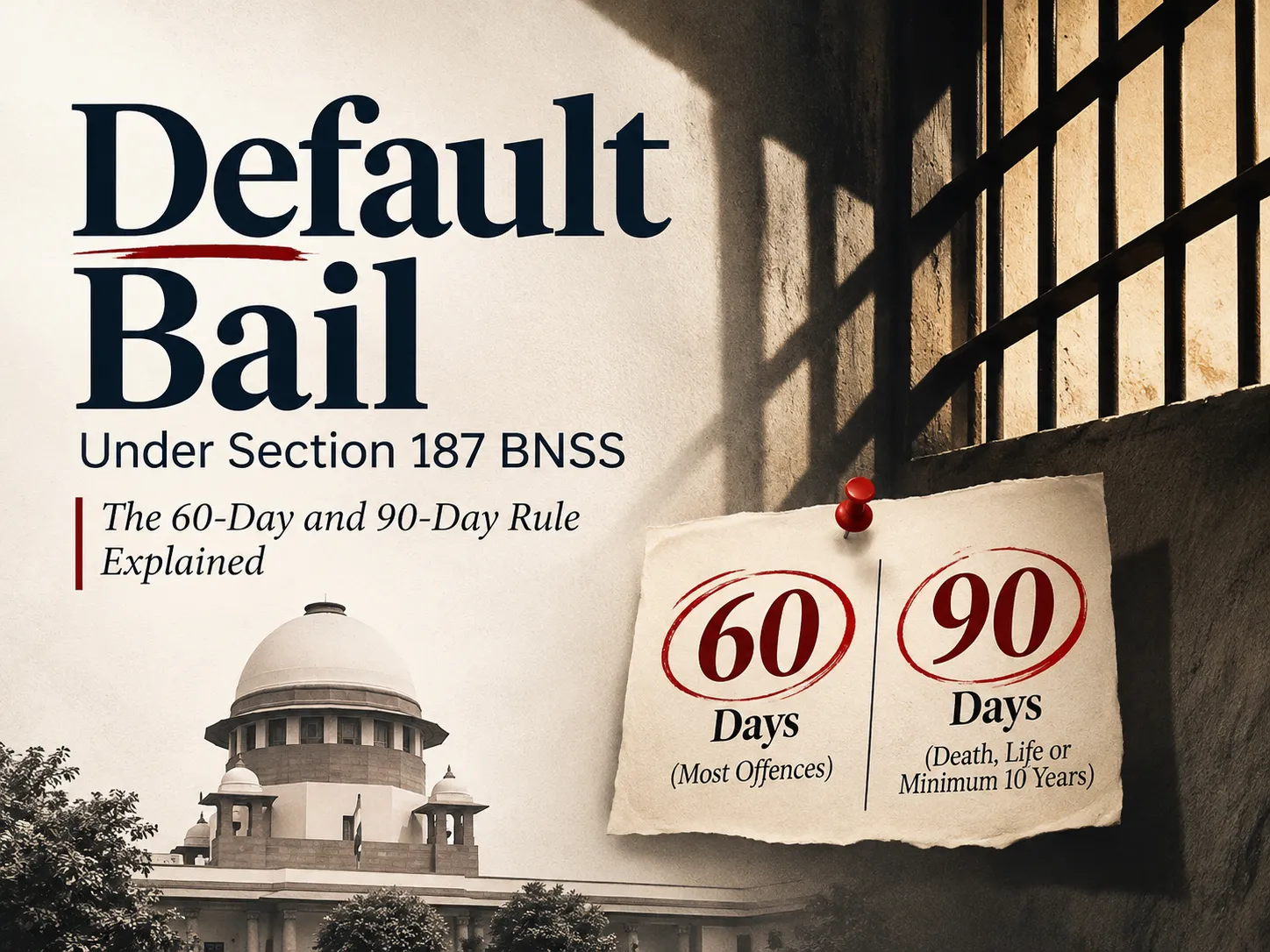
| Section 187(3) | Total detention cannot exceed 90 days (death, life or minimum 10 years) or 60 days (other offences); after that, the accused is released on bail if ready to furnish it |
| Section 193 | Police report (chargesheet) after investigation; replaces Section 173 CrPC |
| Chapter XXXV | Bail provisions that apply to a person released under Section 187(3) |
You can read the Sanhita on India Code and the judgments mentioned below on the Supreme Court website and Indian Kanoon.
CrPC 167 vs BNSS 187: what changed
| Point | Section 167 CrPC | Section 187 BNSS |
|---|---|---|
| Total detention cap | 90 or 60 days | 90 or 60 days (unchanged) |
| Police custody | 15 days, generally in the first 15 days | 15 days, which may be taken in parts within the first 40 or 60 days |
| Clock runs from | Order of remand | Order of remand |
| Chargesheet provision | Section 173 | Section 193 |
| Default bail right | Indefeasible | Indefeasible, same principles apply |
So the default bail right itself is carried forward. The key change is that police custody can now be split into spells across a longer window. This gives investigators more flexibility, but it also invites a practical question, which courts are now answering: how far can that flexibility be stretched?
The 60-day and 90-day default bail clock
| Offence category | Chargesheet deadline | Default bail arises on |
|---|---|---|
| Punishable with death, life imprisonment, or a minimum of 10 years | 90 days | Expiry of 90 days |
| Every other offence | 60 days | Expiry of 60 days |
The “ten years” trap. Section 187(3) uses the words “not less than ten years”. In Rakesh Kumar Paul v. State of Assam (2017) 15 SCC 67, the Supreme Court dealt with this exact question under Section 167 CrPC. Broadly, where the law prescribes only a maximum of ten years, the 60-day period applies. The 90-day period applies where the minimum punishment is ten years or more. Check the sentencing clause of each section in the FIR carefully, because the section decides the clock.
How to count
The period runs from the date of the first remand order, not from the arrest. This was settled long ago in Chaganti Satyanarayana v. State of Andhra Pradesh (1986) 3 SCC 141. If a person is arrested on 1 March but first produced and remanded on 2 March, the count begins on 2 March. Ask your lawyer to compute the exact date, because a single day can decide the application.
- Arrest.
- Produced before Magistrate within 24 hours.
- First remand order (clock starts).
- Day 60 / Day 90 expires without chargesheet.
- Application for default bail + offer of surety.
- Release on bail (Chapter XXXV conditions apply).
Police custody and the 40/60-day window
Many people misread the 60 and 90 days as the time the police can keep a suspect in their custody. That is wrong. Under Section 187(2), the police can get at most 15 days of police custody in total. The BNSS lets the Magistrate authorise those days “in the whole or in parts”, at any time within the first 40 days (in 60-day cases) or the first 60 days (in 90-day cases). The rest of the detention is judicial custody.
The Supreme Court has addressed this in recent months. In Pogadadabnda Revathi v. State of Telangana (2026 INSC 75, decided 9 January 2026), as reported, the Court stressed that the investigation period does not authorise continuous police interrogation for 40, 60 or 90 days. In State of Andhra Pradesh v. Suda Suresh Veera Venkata Naga Raju, reported in 2026, the Court held that Section 187(2) enlarges the window in which police custody may be sought and allowed the balance days to be granted so that the total did not exceed 15. I have confirmed these from reports and secondary sources. Please check the full judgments on the Court’s website for the exact reasoning before relying on them.
Important: Unused police custody days do not stop the default bail clock. If the 60 or 90 day period ends without a chargesheet, the right accrues, whatever the police say about “ongoing” custody needs.
7 steps to claim default bail
- Note the date of the first remand order. Get a copy of the remand order from the court file. That date is day one.
- Identify the offence category. List every section in the FIR and check its punishment. This tells you whether the deadline is 60 or 90 days.
- Check the status of the chargesheet. Ask the court registry whether a police report under Section 193 BNSS has been filed. Do not rely on the police’s word.
- File the application on the first day the period expires, not later. Waiting is dangerous (see the next section).
- State the facts clearly. Give the date of arrest, date of first remand, the section and punishment, the date the period ended, and say that no chargesheet has been filed. Add that the accused is ready to furnish bail and surety.
- Ask for an urgent hearing and press the court to decide the application the same day. Courts have repeatedly said that the application must be decided before a chargesheet is filed.
- Furnish the bail bond and surety on the court’s terms. The right is to be released if the accused is prepared to and does furnish bail. Without the surety, release does not follow.
Documents checklist
- Remand orders and arrest memo
- FIR copy with the sections invoked
- Order sheet showing no chargesheet on file
- Surety documents (ID, address proof, property or income proof as the court asks)
- Vakalatnama and application with affidavit, if required locally
When default bail is lost
Default bail is powerful, but it is a right that can be lost through bad timing.
- Chargesheet filed in time. If a proper police report is filed before the 60 or 90 days end, no default bail right accrues.
- Chargesheet filed after the period but before you apply. In Uday Mohanlal Acharya v. State of Maharashtra (2001) 5 SCC 453, a three-judge bench held that the right must be claimed by applying and offering bail before the chargesheet is filed. If the police file first, the right is lost, though regular bail remains open.
- Application filed, but then the chargesheet comes. The Supreme Court has held that the accused who has properly applied cannot be defeated by a later chargesheet. See M. Ravindran v. Intelligence Officer, Directorate of Revenue Intelligence (2021) 2 SCC 485.
- Failure to furnish bail. Entitlement alone is not enough. Surety must be furnished.
Special laws and default bail
Special statutes can change the numbers. The Unlawful Activities (Prevention) Act, 1967 allows longer periods in specified cases, and the Narcotic Drugs and Psychotropic Substances Act, 1985 has its own scheme. In Bikramjit Singh v. State of Punjab (2020) 10 SCC 616, the Supreme Court held that default bail is part of the right to liberty under Article 21 and that only the competent Magistrate or court can extend the investigation period under the UAPA. If your case is under a special law, read that law’s detention clause before computing days.
Do not confuse default bail with Section 479 BNSS, which allows release of undertrial prisoners who have served a fixed fraction of the maximum sentence. They are different rights with different triggers.
Important judgments
| Case (Supreme Court) | Citation | Why it matters |
|---|---|---|
| Uday Mohanlal Acharya v. State of Maharashtra | (2001) 5 SCC 453 | Right accrues on expiry of period; must be claimed before chargesheet is filed |
| Chaganti Satyanarayana v. State of A.P. | (1986) 3 SCC 141 | Period counted from date of remand |
| Rakesh Kumar Paul v. State of Assam | (2017) 15 SCC 67 | Meaning of “ten years” for the 60 vs 90 day question |
| Bikramjit Singh v. State of Punjab | (2025) | Default bail is part of Article 21; special-law extensions strictly construed |
| M. Ravindran v. Intelligence Officer, DRI | (2021) | Properly claimed right cannot be defeated by later chargesheet |
| Shaurya Sunil Kumar Singh v. CBI (1 July 2026) | Case details on the Court website | Non-supply of additional copies of chargesheet does not create default bail |
Always read the primary text. I have listed older citations from memory of the law reports, so please verify them on Indian Kanoon before citing them in a pleading.
Recent Supreme Court rulings (2026)
Non-supply of chargesheet copies is not default bail
On 1 July 2026, a bench of Justices Sanjay Karol and N. Kotiswar Singh dismissed an appeal by Shaurya Sunil Kumar Singh in a CBI case. The accused had argued that copies of the chargesheet were not supplied within the statutory period. The Court disagreed. It held that default bail arises only when the chargesheet itself is not filed in time, and that failing to file additional copies under Section 193(8) BNSS does not invalidate the chargesheet or revive the right. The chargesheet had been filed on 2 September 2025, within time, and the copy was supplied on 23 September 2025. The Court said the accused should seek regular bail, and his pending regular bail application would be considered on merits.
This matters for anyone planning a default bail application. A proper chargesheet filed in time, even if copies reach you later, ends the default bail route. Regular bail remains available.
Custody in parts
As covered above, the 2026 decisions on police custody under Section 187(2) make clear that custody can be sought in spells, but the 15-day total stands and the 60/90 day periods are not licences for continuous interrogation.
Myths vs facts
| Myth | Fact |
|---|---|
| Default bail is automatic release on day 61. | No. The accused must apply and furnish bail. |
| It depends on how serious the crime is. | Only the offence category (60 or 90 days) matters, not the court’s view of the merits. |
| The clock starts on the day of arrest. | It runs from the date of the first remand order. |
| Police can hold me in police custody for 60 or 90 days. | Police custody is capped at 15 days in total. |
| A late chargesheet always gives default bail. | Not if it is filed before you apply. |
| Not receiving copies of the chargesheet gives default bail. | The Supreme Court rejected this in July 2026. |
Common mistakes
- Miscounting the days or starting from the arrest date.
- Assuming the 90 day rule applies because the offence is “serious”, without checking the minimum punishment.
- Waiting a few days after the period ends, and losing the right when the chargesheet arrives.
- Applying without offering surety, or without a surety ready.
- Believing that regular bail and default bail are the same thing.
- Relying on oral assurances about chargesheet status instead of checking the court record.
Frequently asked questions
1. What is default bail in simple words?
It is bail you can claim as a right when the police fail to file a chargesheet within 60 or 90 days of remand.
2. Which section governs default bail now?
Section 187(3) of the BNSS, which replaced Section 167(2) CrPC from 1 July 2024.
3. How many days are needed for default bail?
Sixty days for most offences and ninety days for offences punishable with death, life or a minimum of ten years.
4. When does the clock start?
From the date of the first remand order, not from arrest.
5. Is default bail automatic?
No. You must apply, offer bail, and furnish surety.
6. What if the police file the chargesheet after the deadline?
If you had already applied, the right survives. If the chargesheet is filed before you applied, the default bail right is lost.
7. Can the court refuse default bail because the crime is serious?
No, once the right accrues and the conditions are met. Seriousness is relevant only to regular bail.
8. Does non-supply of chargesheet copies give default bail?
No. The Supreme Court held on 1 July 2026 that only non-filing of the chargesheet itself triggers the right.
9. How long can the police keep me in police custody?
A maximum of 15 days in total, which can now be taken in parts within the first 40 or 60 days.
10. Can default bail be cancelled?
Yes, in appropriate cases, for example for violating conditions or when new circumstances arise.
11. Does default bail apply under special laws like UAPA or NDPS?
Yes in principle, but those laws can prescribe different periods, so check the specific statute.
12. Is default bail the same as regular bail?
No. Regular bail depends on the court’s view of the merits. Default bail depends on the time limit.
13. What if the accused cannot arrange surety?
The right is to release “if ready to and does furnish bail”, so surety is required. The court may be asked to reduce the amount in a suitable case.
Conclusion
Default bail is a modest right in wording and a powerful one in effect. It forces the investigating agency to work inside a time limit. But it rewards the alert. Know the date of remand, know which clock applies, and file the application on the first day the period expires.
The BNSS has kept the right intact while reshaping how police custody is spread. Courts in 2026 have made two things clear: a proper chargesheet filed in time ends the right, and the 60 or 90 days are never a licence for open-ended custody.
Key takeaways
- Default bail comes from Section 187(3) BNSS.
- 60 days for most offences, 90 days for the gravest.
- The clock runs from the first remand order.
- Apply before the chargesheet is filed, and be ready with surety.
- Police custody is capped at 15 days, in parts if needed.
- Non-supply of chargesheet copies does not create the right.
Related reading:
Cybercrime complaint filing, and cheque bounce case under Section 138.