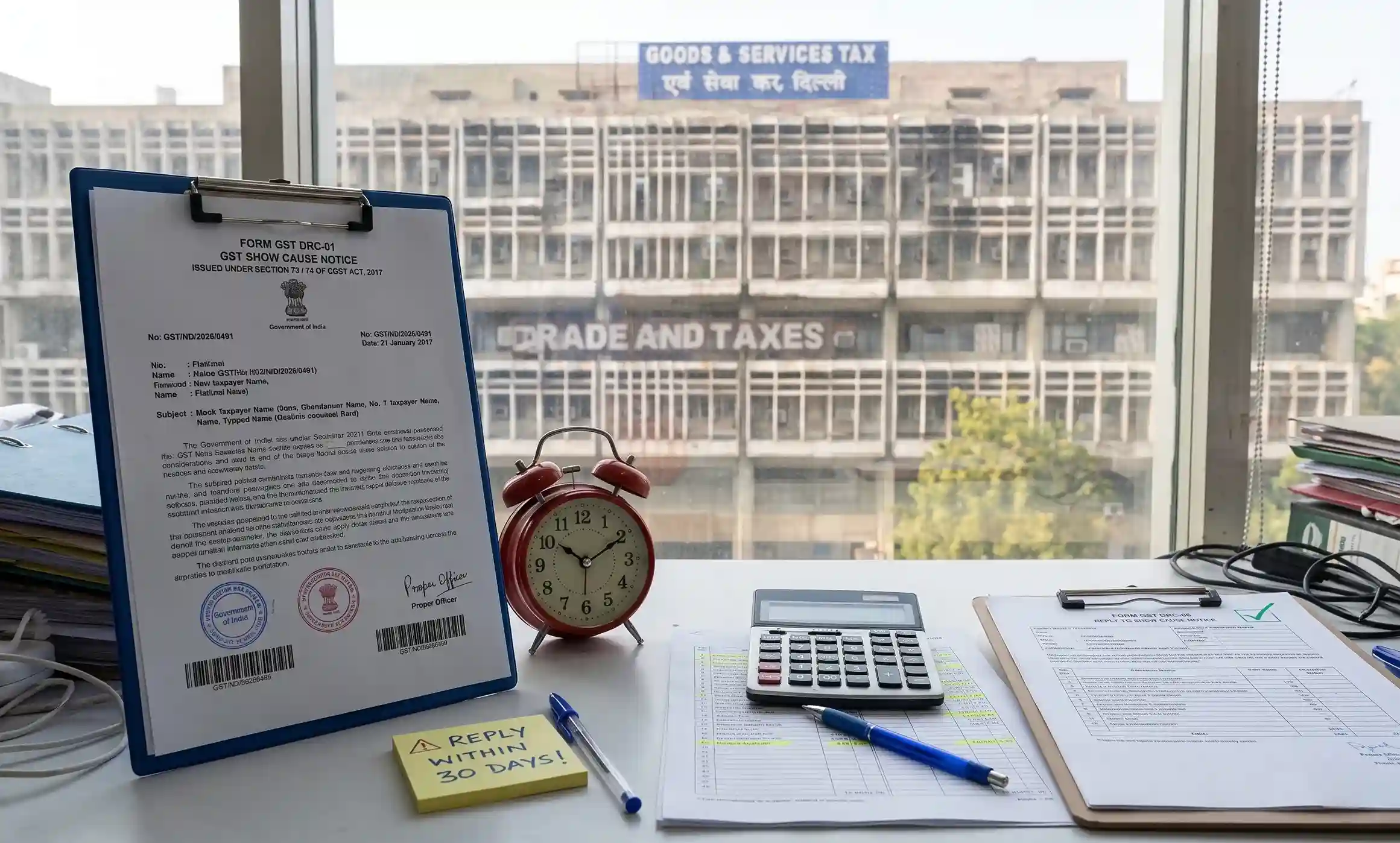
The email looks harmless: “Notice under Section 73”. The portal shows a PDF, a number and a date. Many small businesses glance at it, assume the accountant will handle it, and forget. Thirty days later an order arrives with tax, interest and a penalty added.
A GST show cause notice is the most important document in a GST dispute, because it fixes the case against you. The department cannot go beyond what the notice alleges, and your reply forms the record on which every later appeal rests. This guide explains the law, the time limits, a step-by-step reply plan, and two recent Supreme Court rulings that every taxpayer should know.
What is a GST show cause notice?
A GST show cause notice is a formal notice issued by the “proper officer” under the Central Goods and Services Tax Act, 2017. It lists the amount the department believes you owe, the period, and the reasons, and asks you to show cause why that amount should not be recovered along with interest and penalty. Form GST DRC-01 is the summary of the notice, your reply is in Form GST DRC-06, and the final order is summarised in Form GST DRC-07 under Rule 142 of the CGST Rules.
It is not an order. Nothing is payable merely because a notice has been issued, except what you admit. But the notice starts the clock for your reply, and what you say, or fail to say, becomes the record.
Why a GST show cause notice is issued
The common triggers are:
- Mismatch between GSTR-1 and GSTR-3B, or between GSTR-3B and GSTR-2B
- Input tax credit claimed that the department says is ineligible or not reflected
- Short payment of tax or wrong classification or rate
- Erroneous refund
- Tax collected but not deposited
- Audit observations by departmental or CAG audits
Most notices begin as data mismatches. Many of them can be explained with a clear reconciliation, which is why a calm, well-organised reply matters more than a long, angry one.
Section 73 vs 74 vs 74A
| Point | Section 73 | Section 74 | Section 74A |
|---|---|---|---|
| Applies to | Non-fraud cases, periods up to FY 2023-24 | Fraud, wilful misstatement or suppression, periods up to FY 2023-24 | All cases from FY 2024-25 onwards |
| Time limit for order | 3 years from due date of annual return | 5 years from due date of annual return | Notice within 42 months; order within 12 months of notice |
| Notice must be issued | At least 3 months before the order deadline | At least 6 months before the order deadline | Within the 42-month period |
| Penalty if adjudicated | 10% of tax or ₹10,000, whichever is higher | 100% of tax | Same quantum, split by fraud or non-fraud |
| Penalty if paid early | None if tax and interest are paid before notice or within 30 days of it | Reduced: 15%, 25% or 50% depending on the stage | Similar ladder, with longer payment windows (reported as 60 days) |
The Finance (No. 2) Act, 2024 introduced Section 74A with effect from FY 2024-25 to merge the fraud and non-fraud tracks into one framework. Sections 73 and 74 remain alive for earlier years. A notice for FY 2024-25 that wrongly cites Section 73 or 74 has been treated by High Courts as showing non-application of mind. Check the section on the first page. You can read the Act on India Code and the GST portal and forms on gst.gov.in.
Before the notice: DRC-01A and ASMT-10
Many cases begin before the formal notice. An ASMT-10 is a scrutiny notice about return discrepancies. A DRC-01A is an intimation of tax ascertained as payable, issued before a Section 73, 74 or 74A notice. If you receive either, reply or pay as appropriate. A well-reasoned reply at this stage often ends the matter before it becomes a GST show cause notice. Ignoring them just moves the issue to the next level.
7 steps to reply to a GST show cause notice
- Read the notice completely and note the dates. Record the date of issue, the date you saw it, the section, the period, the amount for tax, interest and penalty, the officer’s name and the date of the hearing, if given. Download every annexure.
- Test jurisdiction and limitation first. Was it issued within the time allowed under Section 73, 74 or 74A? Is the correct section applied for the period? Does the officer have authority to issue it? Many notices fail here, before you reach the merits.
- Collect the documents the department relies on, and ask for time if you need it. If pages or relied-upon documents are missing, write to the officer immediately and keep the acknowledgement. Request an extension in a separate letter and repeat it in the reply.
- Reconcile your numbers. Match GSTR-1, GSTR-3B, GSTR-2B, e-invoices, e-way bills and your books for each head of demand. A neat reconciliation annexure is the most effective part of any reply.
- Pay what is genuinely owed through Form GST DRC-03. Paying admitted tax and interest stops further interest and strengthens your credibility on the disputed balance. Do not pay under pressure for amounts you can defend, and note that payment should not be described as an admission of the whole demand.
- Draft and file the reply in Form GST DRC-06 on the portal within the time given, ordinarily 30 days, attaching your reconciliation and documents.
- Ask for a personal hearing and attend it. State the request clearly in the reply and again by letter. Bring a short written note of your arguments.
Documents checklist
- Complete copy of the notice with all annexures and relied-upon documents
- GSTR-1, GSTR-3B, GSTR-2A and 2B for the period
- Purchase and sales ledgers, invoices, e-way bills and e-invoice records
- Bank statements and proof of payment to suppliers
- Supplier registration and return-filing status, if ITC is disputed
- Previous correspondence with the department
- Board resolution or authorisation letter if a representative files
How to draft the DRC-06 reply
The format of a strong reply is simple.
- Heading and reference: notice number, date, section, period, and your GSTIN.
- Preliminary objections: limitation, wrong section, missing documents, lack of jurisdiction, vague allegations, and absence of foundational facts for fraud or suppression.
- Brief background: your business and how the transactions work, in two or three short paragraphs.
- Paragraph-wise reply: respond to each allegation in the same numbered order as the notice. Do not argue in general terms.
- Reconciliation statement: head-wise, with document references.
- Legal submissions: only the points that matter, with case law if relevant.
- Prayer: drop the proceedings, or in the alternative reduce the demand, with no penalty, and grant a personal hearing.
Keep it factual. Avoid accusations against the officer. Number your annexures and refer to them in the text so the officer can verify each claim.
Personal hearing and natural justice
Section 75(4) of the CGST Act requires an opportunity of hearing where a request is made or where an adverse decision is contemplated. Section 75(5) limits adjournments to a maximum of three. Section 75(6) requires the order to set out the relevant facts and the basis of the decision, and Section 75(7) says the amount in the order cannot exceed the amount specified in the notice.
High Courts have set aside orders passed where the hearing was fixed before the reply deadline ended, or where the officer ignored a reply already on file. If you declined a hearing on the portal at the time of replying, you can still raise natural justice in appeal if the order was adverse. Do not rely on this. Ask for the hearing in clear words.
After the reply: the order and your appeal
If the officer is not satisfied, he passes an order in Form GST DRC-07. If you miss the reply window, the officer can pass an order without hearing your side.
| Stage | Where | Time and pre-deposit |
|---|---|---|
| First appeal | Appellate Authority under Section 107 (Form GST APL-01) | 3 months from the order, extendable by 1 month; 10% of disputed tax, with a cap of ₹20 crore each for CGST and SGST or IGST |
| Second appeal | GST Appellate Tribunal (GSTAT) under Section 112 | Further pre-deposit reported as 10% of the disputed tax; check the current cap and time limit |
| Higher courts | High Court or Supreme Court | On questions of law, or by writ in cases of jurisdictional or natural justice defects |
Reports in 2026 said the Principal Bench of the GSTAT began hearing cases in February 2026 and State Benches are being rolled out. The pre-deposit rule for penalty-only appeals introduced from 1 October 2025 is being tested in the Supreme Court, which in September 2026 allowed one assessee to file a GSTAT appeal without pre-deposit, subject to the final outcome. Verify the current rules before you file.
Important judgments
| Case (Supreme Court) | Citation | Why it matters |
|---|---|---|
| Tata Steel Limited v. Union of India (Pardiwala and K. Vinod Chandran, JJ., 25 August 2026) | 2026 INSC 920; 2026 LiveLaw (SC) 862 | Extended limitation under Section 74 needs foundational facts in the notice, not a bare allegation of suppression; officer must apply his own mind |
| G.R. Infra Projects Limited, Ratlam v. State of Madhya Pradesh (19 August 2026) | Civil Appeal No. 11277 of 2026 | Section 74 notice that merely alleges “fraud” without facts was set aside |
| Oryx Fisheries Pvt. Ltd. v. Union of India | (2010) 13 SCC 427 | A show cause notice must be issued with an open mind, not as a pre-determined conclusion |
| Gorkha Security Services v. Government (NCT of Delhi) | (2014) 9 SCC 105 | The notice must clearly state the grounds so that the noticee can reply |
Please read the full judgments on the Supreme Court website or Indian Kanoon before citing them.
Recent developments (2025-26)
The Tata Steel ruling
In the August 2026 judgment, the Court dealt with a notice issued in June 2025 for FY 2018-19 to 2020-21, which began with audit observations. The ordinary three-year period under Section 73 had expired, and the department revived the matter under Section 74 as a “protective demand”. The Court held that the extended limitation cannot rest on mere recitals of fraud, wilful misstatement or suppression; the foundational facts must be visible in the notice itself. It also held that the proper officer must reach his own satisfaction before issuing a notice, rather than mechanically follow an audit objection. The notice and the consequent order were set aside, though the department was given liberty to start fresh proceedings in accordance with law. Raise this as a preliminary objection when a Section 74 notice is vague.
Section 128A amnesty
Section 128A offered a waiver of interest and penalty for certain Section 73 demands for FY 2017-18 to 2019-20, subject to payment of tax by 31 March 2025. That window has closed, so do not plan around it unless a new notification extends it.
Pending question: the three-month rule
Section 73(2) requires a notice at least three months before the order deadline. In November 2026, the Supreme Court was reported to have issued notice on how that three-month period is to be computed in a challenge to a Gauhati High Court judgment. Until it is decided, take the position from your own facts and check with a tax lawyer.
Myths vs facts
| Myth | Fact |
|---|---|
| A show cause notice means I must pay immediately. | No. It is a request to explain, not an order. |
| I can ignore it if I did nothing wrong. | No. Silence can lead to an ex parte order. |
| Every notice with the word “fraud” is automatically valid. | The Supreme Court has held that facts must back the allegation. |
| The reply can be filed any time. | It should be filed within the time given, usually 30 days. |
| One notice can be fixed later in the order. | The order cannot exceed the amount in the notice, and must be based on its grounds. |
| Paying a part means I lose the right to contest. | Payment of admitted tax does not stop you from contesting the balance, if you record it properly. |
Common mistakes
- Waiting until the last day, then missing the portal upload.
- Replying generally (“we deny everything”) instead of paragraph by paragraph.
- Skipping the limitation and section check.
- Not asking for the documents the department relies on.
- Declining a hearing on the portal without thinking.
- Paying disputed amounts under pressure, with no written protest.
- Using a consultant’s template reply that does not match the notice.
- Ignoring a DRC-01A, and letting it turn into a full notice.
Frequently asked questions
1. What is a GST show cause notice?
It is a notice calling on you to explain why tax, interest and penalty should not be demanded, issued under Section 73, 74 or 74A.
2. Which form is used to reply?
Form GST DRC-06, filed on the GST portal.
3. How many days do I have to reply?
Ordinarily 30 days from the notice. Check the date mentioned in your notice, and ask for an extension in writing if needed.
4. What happens if I do not reply?
The officer can pass an order in DRC-07 on the basis of the record, without hearing your side.
5. What is the difference between Section 73 and Section 74?
Section 73 covers non-fraud cases with a three-year limit. Section 74 covers fraud, wilful misstatement or suppression with a five-year limit and higher penalty.
6. What is Section 74A?
The provision that governs demand notices from FY 2024-25 onwards, with a uniform 42-month period for the notice and 12 months for the order.
7. Can I pay and close the matter?
Yes. In non-fraud cases, paying tax and interest early can end the proceedings without penalty. Pay only what you owe.
8. What is DRC-03?
The form for making a voluntary payment of tax and interest against a demand or on your own.
9. Can I ask for a personal hearing?
Yes. Section 75(4) requires an opportunity of hearing where requested or where an adverse decision is contemplated.
10. Can one notice cover several financial years?
Courts have differed. A Karnataka High Court division bench was reported to have allowed multi-year notices, while others have insisted on year-wise notices. Check the latest ruling of your High Court.
11. How do I challenge an order?
File a first appeal under Section 107 in Form GST APL-01 within three months, with the pre-deposit.
12. Is there a pre-deposit?
Yes, 10% of the disputed tax for the first appeal, subject to a cap, and a further amount for the GSTAT appeal.
13. What if the notice is vague about fraud?
Take a preliminary objection on limitation and absence of foundational facts, relying on the Supreme Court’s August 2026 rulings.
14. Can I get more time?
Write to the officer with reasons before the deadline. Time is usually given, but you must ask in time.
Conclusion
A GST show cause notice is stressful, but it is also an opportunity: the department has shown its hand, and you have a chance to answer before any order exists. The strongest replies do three things. They check limitation and the section first, they reconcile the numbers honestly, and they speak to every paragraph of the notice.
The law is moving. The shift to Section 74A, the August 2026 rulings on fraud allegations and the arrival of the GSTAT all change the playing field. Keep your documents organised, never miss a date, and take professional help early for any notice involving large amounts or fraud allegations.
Key takeaways
- Sections 73 and 74 apply up to FY 2023-24; Section 74A applies from FY 2024-25.
- Reply in Form GST DRC-06, usually within 30 days.
- Check limitation and foundational facts before the merits.
- Reconcile GSTR-1, 3B and 2B with your books.
- Pay admitted tax through DRC-03 and contest the rest.
- Ask for a personal hearing, and appeal within three months.
Related reading on Lawyush:
startup incorporation in India,
trademark registration, and
consumer complaint online.