Quick Summary: For most funded or growth-focused startups, a Private Limited Company is the standard choice. An LLP suits professional services and small partnerships that want low compliance and no equity funding. An OPC suits a solo founder who wants limited liability. Startup incorporation is done online through SPICe+ on the MCA portal for companies, and FiLLiP for LLPs.
Most founders spend weeks choosing a name and about five minutes choosing a legal structure. That is backwards. The structure decides who is liable when something goes wrong, whether an investor will touch your cap table, how much compliance you carry every year, and how easy it is to bring in a co-founder later.
This guide covers startup incorporation in India in plain terms: the three common structures, how they compare, the step-by-step process, annual compliance, and the 2025-26 changes that matter to a new founder.
What is startup incorporation?
Startup incorporation means giving your business a legal identity of its own, separate from you as a person. Instead of “Ravi sells software”, the contracts, bank account and assets belong to “Ravi Tech Private Limited” or “Ravi Tech LLP”. The business can sign agreements, own property, sue and be sued in its own name.
That separation is the whole point. It is why a creditor of a company cannot ordinarily go after the shareholders’ personal homes, and why investors are willing to put money into a company rather than into a person.
Did you know? “Startup” is not a legal structure. A startup is any of these entities that also qualifies for recognition under the DPIIT scheme. Incorporation comes first, recognition comes after.
Three structures for startup incorporation
1. Private Limited Company
Governed by the Companies Act, 2013. It needs at least two shareholders and two directors, and at least one director must be resident in India, meaning a stay of at least 182 days in the previous calendar year. A private company can have up to 200 members. There is no minimum paid-up capital requirement. Shareholders’ liability is limited to the unpaid amount on their shares.
2. Limited Liability Partnership (LLP)
Governed by the Limited Liability Partnership Act, 2008. It needs at least two partners, with at least two designated partners who are individuals, and at least one of them resident in India. Partners’ liability is limited to their agreed contribution, and a partner is not liable for the independent acts of other partners. An LLP is governed by the LLP agreement, which gives freedom to design internal rules.
3. One Person Company (OPC)
An OPC is a company with a single member, introduced by the Companies Act, 2013. The sole member must nominate another person who will step in if the member dies or becomes incapable. After the 2021 amendment to the Incorporation Rules, the member must be a natural person who is an Indian citizen, and non-resident Indians are now allowed. Residency is defined as a stay of at least 120 days in the preceding financial year. An OPC can convert to a private or public company at any time. It cannot carry on non-banking financial activities, including investment in securities.
Private Limited vs LLP vs OPC: comparison
| Feature | Private Limited | LLP | OPC |
|---|---|---|---|
| Governing law | Companies Act, 2013 | LLP Act, 2008 | Companies Act, 2013 |
| Minimum people | 2 directors, 2 shareholders | 2 partners (2 designated) | 1 member, 1 nominee, 1 director |
| Liability | Limited to unpaid share capital | Limited to contribution | Limited to unpaid share capital |
| Separate legal entity | Yes | Yes | Yes |
| Raising equity (VC, angels) | Easy: shares, ESOPs, convertible notes | Difficult: no shares | Practically very limited |
| Compliance burden | Highest of the three | Lowest | Moderate |
| Statutory audit | Mandatory | Only above prescribed limits | Mandatory |
| DPIIT recognition | Eligible | Eligible | Not eligible |
| Best for | Product startups, funded businesses | Consulting, agencies, family or professional ventures | Solo founders testing an idea |
Which structure should you choose?
- Planning to raise venture or angel funding? Choose Private Limited. Most investors insist on it.
- Selling services with two or three partners and little outside money? An LLP keeps compliance light and gives limited liability.
- Solo founder who wants liability protection? An OPC works, but plan to convert to a Private Limited Company when a co-founder or investor joins.
- Want ESOPs for employees? A company can issue them. An LLP cannot.
- Cost-sensitive and early? LLP and OPC are lighter, but weigh that against the conversion cost later.
Tip: Choose the structure for the company you expect to be in 24 months, not the company you are today. Converting later is possible, but it costs time, money and sometimes tax, and investors may ask for clean history.
6 steps for startup incorporation
The steps below follow the company route. An LLP follows a similar pattern with Form FiLLiP.
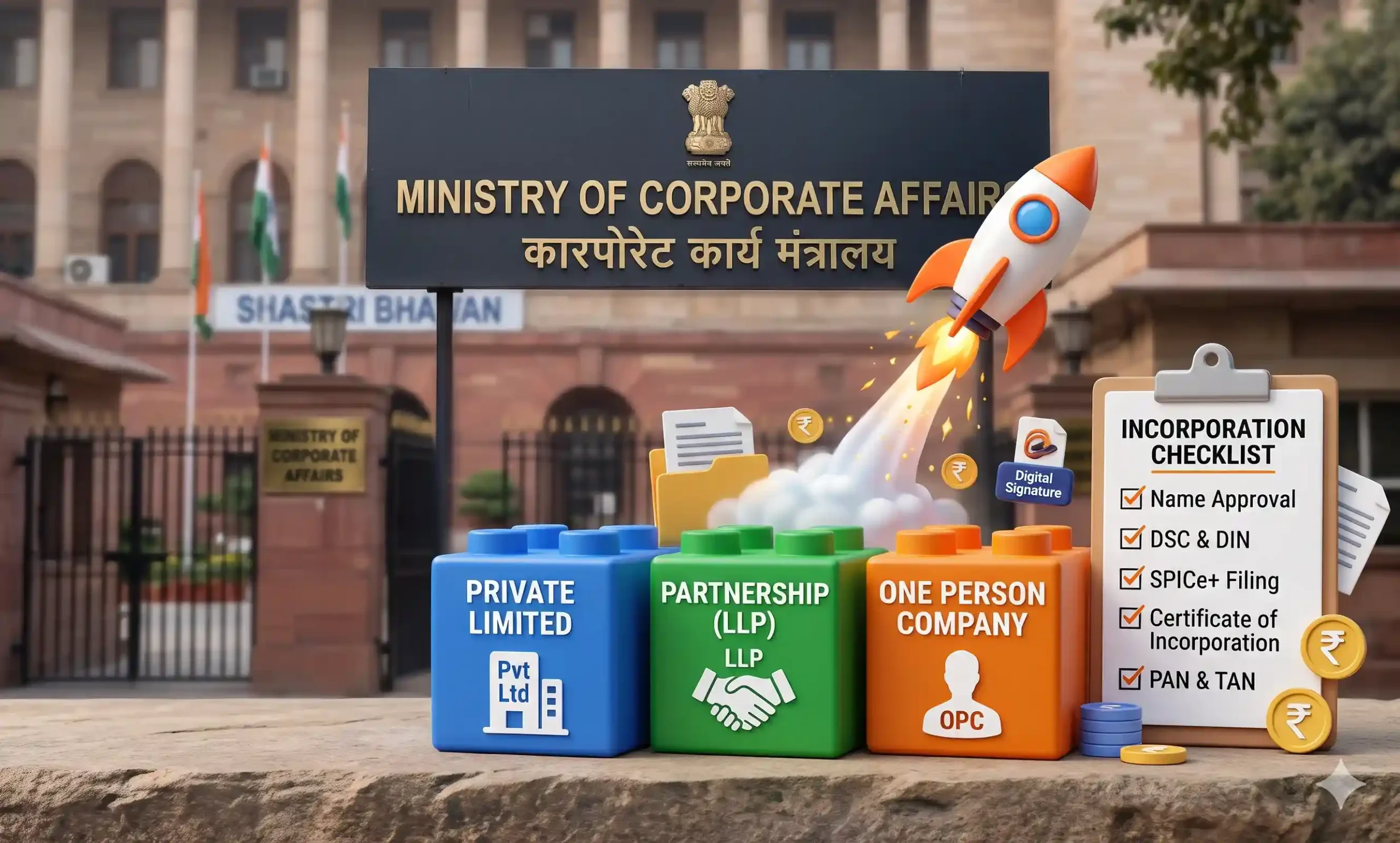
- Pick the structure and the founders’ roles. Decide who will be directors and shareholders (or partners), and their holdings. Put the founders’ agreement in writing early, because the incorporation papers do not capture vesting, roles or exit.
- Get Digital Signature Certificates. Proposed directors need a DSC to sign electronic forms. Director identification is handled through the incorporation form for first-time directors.
- Choose and reserve the name. Part A of the integrated SPICe+ form lets you propose names. The name must not be identical or too similar to an existing company or a registered trademark. Run a trademark search alongside the MCA check.
- File SPICe+ (Form INC-32) with the MOA and AOA. The integrated form covers incorporation, DIN, PAN, TAN and, where applicable, GST, EPFO and ESIC registration. You also provide the registered office address with proof of occupancy.
- Receive the Certificate of Incorporation. The Registrar of Companies issues the certificate with the Corporate Identity Number (CIN). Your company exists from the date mentioned on it.
- Complete post-incorporation tasks. Open the bank account, issue share certificates, appoint the first auditor within 30 days (Form ADT-1), and file the declaration for commencement of business (Form INC-20A) within 180 days. Also register for GST, Udyam and, if eligible, DPIIT recognition.
Documents checklist
- PAN and Aadhaar of directors or partners
- Passport-size photographs and address proof
- Registered office proof, such as a rent agreement with a no-objection letter and a recent utility bill
- Digital Signature Certificates of proposed directors
- MOA and AOA (for a company), or an LLP agreement (for an LLP)
- Nominee’s consent and details (for an OPC)
For LLPs, the LLP agreement must be filed in Form 3 within 30 days of incorporation. The official portal for all filings is mca.gov.in, and the statutes are on India Code.
Tax and funding angle
| Point | Company (Pvt Ltd / OPC) | LLP |
|---|---|---|
| Income tax rate | Concessional regime under Section 115BAA: 22% plus surcharge and cess (about 25.17% in effect) | Taxed like a firm: 30% plus surcharge and cess |
| Profit distribution | Dividend taxed in the shareholder’s hands | Partners’ share of profit not taxed again |
| Equity funding | Straightforward through shares | Not possible through shares |
| ESOPs | Allowed | Not available |
Please verify rates for the current year on the Income Tax Department website, because surcharge and regime conditions change. The angel tax provision (Section 56(2)(viib)) was abolished by the Finance (No. 2) Act, 2024, which removed one old worry for early-stage companies raising money from investors.
Annual compliance
| Entity | Main yearly filings |
|---|---|
| Private Limited | Statutory audit; AGM; Form AOC-4 (financials) within 30 days of AGM; Form MGT-7 (annual return) within 60 days of AGM; board meetings; DIR-3 KYC for directors; income tax return |
| OPC | Statutory audit; AOC-4; simplified annual return; fewer board meetings; income tax return |
| LLP | Form 8 (statement of account and solvency); Form 11 (annual return); income tax return; audit only if limits are crossed |
Late filing attracts additional fees per day under the MCA rules, and persistent default can lead to disqualification of directors. Treat compliance as part of your startup incorporation budget, not an afterthought. Keeping a calendar from the first day saves far more than it costs.
DPIIT startup recognition
Recognition under the Startup India scheme is optional, but it unlocks benefits such as easier access to some government programmes and, for eligible startups, a possible income tax holiday under Section 80-IAC. The basic conditions have been: the entity is a Private Limited Company, LLP or registered partnership firm; it is within the permitted age since incorporation; its turnover is within the prescribed ceiling; and it works on innovation or scalable job and wealth creation. Limits have been revised in the past and are higher for some deep-tech startups, so check the current DPIIT notification. An OPC is not eligible.
2025-26 changes founders should know
- Small company definition. From 1 December 2025, the Ministry of Corporate Affairs raised the limits for a “small company” to a paid-up capital of up to ₹10 crore and turnover of up to ₹100 crore (Notification G.S.R. 880(E)). Small companies enjoy lighter compliance, for example no cash flow statement and no detailed auditor reporting under CARO. Public companies, holding companies and companies governed by special Acts remain outside the definition.
- Corporate Laws (Amendment) Bill, 2026. The Bill, introduced in the Lok Sabha on 23 March 2026, proposes changes to both the Companies Act and the LLP Act, including simplified incorporation declarations, lighter board meeting requirements for OPCs and small companies, decriminalisation of minor defaults, and higher small-company ceilings. It was referred to a Joint Parliamentary Committee, whose report was reported as tabled on 3 August 2026. I could not confirm whether it has since become law, so treat its changes as proposed until you check the status on the PRS India bill tracker.
- Draft incorporation rules. In April 2026, draft amendments to the incorporation rules were circulated, covering director onboarding and registered office norms. These are drafts. Check the final notification before relying on them.
Important judgments
Incorporation is not only paperwork. These cases explain what a separate legal entity really means.
| Case | Citation | Why it matters |
|---|---|---|
| Salomon v. A. Salomon and Co. Ltd. (House of Lords) | [1897] AC 22 | A company is a separate legal person from its members |
| Tata Engineering and Locomotive Co. v. State of Bihar (Supreme Court) | (1964) 6 SCR 885 | Courts may lift the corporate veil in limited cases |
| Life Insurance Corporation of India v. Escorts Ltd. (Supreme Court) | (1986) 1 SCC 264 | Veil can be lifted where the form hides the real character of a transaction |
| Vodafone International Holdings B.V. v. Union of India (Supreme Court) | (2012) 6 SCC 613 | Corporate structuring and the limits of looking through a holding structure |
| Aneeta Hada v. Godfather Travels and Tours (Supreme Court) | (2012) 5 SCC 661 | A company is a distinct person for prosecution; directors cannot be proceeded against alone in certain statutory offences |
Please check the original text of each judgment on Indian Kanoon before citing it. We have given these citations from the law reports as we know them, and they should be verified.
Myths vs facts
| Myth | Fact |
|---|---|
| A Private Limited Company needs a minimum capital. | No minimum paid-up capital is required. |
| Limited liability means I can never be personally liable. | Personal guarantees, fraud, and statutory liabilities can still reach individuals. |
| LLPs cannot get funding at all. | They cannot issue shares, which makes equity investment impractical, but funding through contributions or loans is possible. |
| An OPC can have a co-founder later without any change. | It must first be converted into a private company. |
| Incorporation makes me a recognised startup. | DPIIT recognition is a separate application. |
| The company exists once I pay the fee. | It exists from the date on the Certificate of Incorporation. |
Common mistakes
- Choosing an LLP or OPC for a business that is certain to seek equity funding.
- Skipping a founders’ agreement, then fighting over equity and roles later.
- Choosing a name that clashes with an existing trademark.
- Using a residential address without the owner’s no-objection letter.
- Forgetting Form INC-20A and the auditor appointment deadline.
- Missing annual filings because “no business happened”.
- Giving a founder shares without a vesting schedule.
- Mixing personal and company funds, which weakens the limited liability protection in practice.
Frequently asked questions
1. Which is best for a startup: Pvt Ltd, LLP or OPC?
For funded or scaling startups, a Private Limited Company. For small service businesses, an LLP. For a solo founder, an OPC.
2. Is there a minimum capital for a Private Limited Company?
No. You can incorporate with a very small paid-up capital.
3. How many directors are required?
A private company needs at least two directors, and an OPC needs at least one. One director of a private company must be resident in India.
4. Can a foreigner be a director?
Yes, provided at least one director is resident in India. Foreign investment rules may apply in some sectors.
5. Can an NRI start an OPC?
Yes, after the 2021 amendment, an Indian citizen who is an NRI can form an OPC.
6. Can an OPC raise venture capital?
Practically no, because it has a single member. It should convert to a company first.
7. Which form is used for startup incorporation?
SPICe+ (INC-32) for companies, and FiLLiP for LLPs, both filed on the MCA portal.
8. How long does incorporation take?
It varies with name approval and document quality. Clean applications are often processed within days, but queries add time.
9. Is a statutory audit compulsory?
Yes for companies, including OPCs. An LLP needs it only above prescribed limits.
10. Do I need a physical office?
You need a registered office address with proof of occupancy. The 2026 draft rules discuss co-working spaces, so check the final rules.
11. What is a small company?
A private company within prescribed limits of paid-up capital and turnover. From 1 December 2025, these are ₹10 crore and ₹100 crore respectively.
12. Can I convert my LLP or OPC later?
Yes. OPCs can convert to a private or public company, and LLPs and companies can convert under the respective Acts, subject to conditions and tax checks.
13. Is DPIIT recognition mandatory?
No. It is optional, but useful if you want to use the scheme’s benefits.
14. Do I need a lawyer or company secretary?
Not legally for the form itself, but professional help is wise for the MOA, AOA and founder agreements.
Conclusion
Startup incorporation is a decision about the future as much as the present. A Private Limited Company asks more of you in compliance but gives you the structure investors understand. An LLP gives flexibility and low maintenance. An OPC protects a solo founder, but it is a stepping stone, not a destination.
Whichever you choose, do three things: write down the founders’ deal, keep your compliance calendar from day one, and revisit the structure as the business grows.
Key takeaways
- Private Limited suits funded startups; LLP suits low-compliance partnerships; OPC suits solo founders.
- Incorporate through SPICe+ (companies) or FiLLiP (LLPs).
- No minimum capital for a Private Limited Company.
- The small company limits are now ₹10 crore capital and ₹100 crore turnover.
- The Corporate Laws (Amendment) Bill, 2026 had not been confirmed as law at the time of writing.
- DPIIT recognition is separate, and OPCs are not eligible.
Related reading on Lawyush:
Trademark registration in India,
Consumer complaint online, and
Cheque bounce case under Section 138.
Legal Disclaimer: This article is for general information and education. It is not legal, tax or financial advice and does not create a lawyer-client relationship. Thresholds, fees and rules change. Verify them on official sources and consult a company secretary, chartered accountant or advocate before choosing a structure.